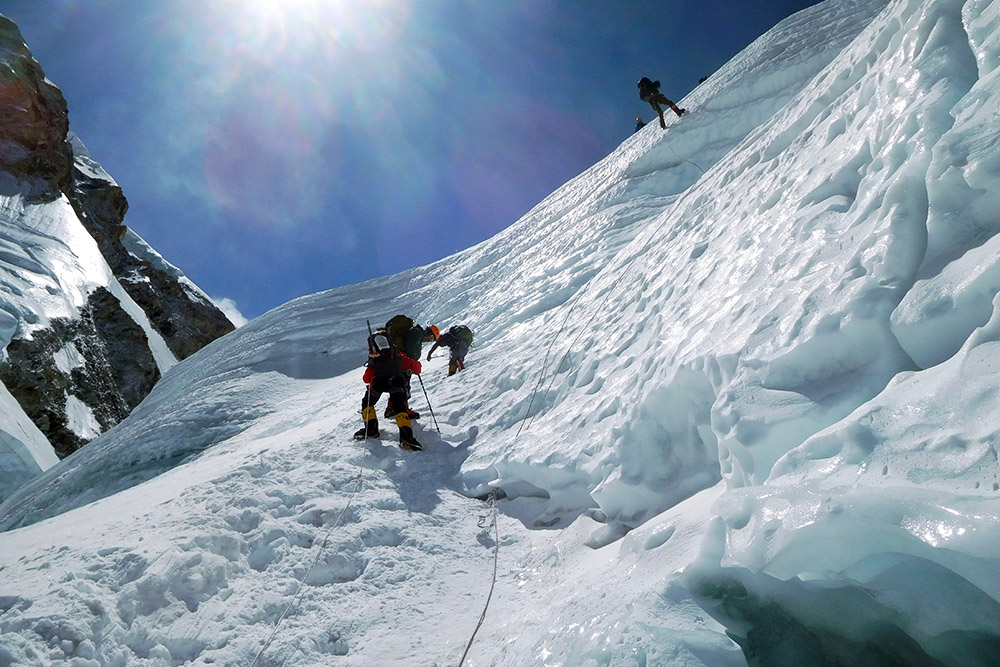
The Khumbu Icefall is the first major challenge of climbing Mt. Everest from the Nepal side. Early in the morning you’ll leave Base Camp and begin your ascent toward Camp I. Without question, the icefall is one of the most dangerous parts of the entire mountain and has claimed many lives over the past several decades. I found that the icefall didn’t look all that steep when viewing it from Everest Base Camp, but that’s a bit misleading.
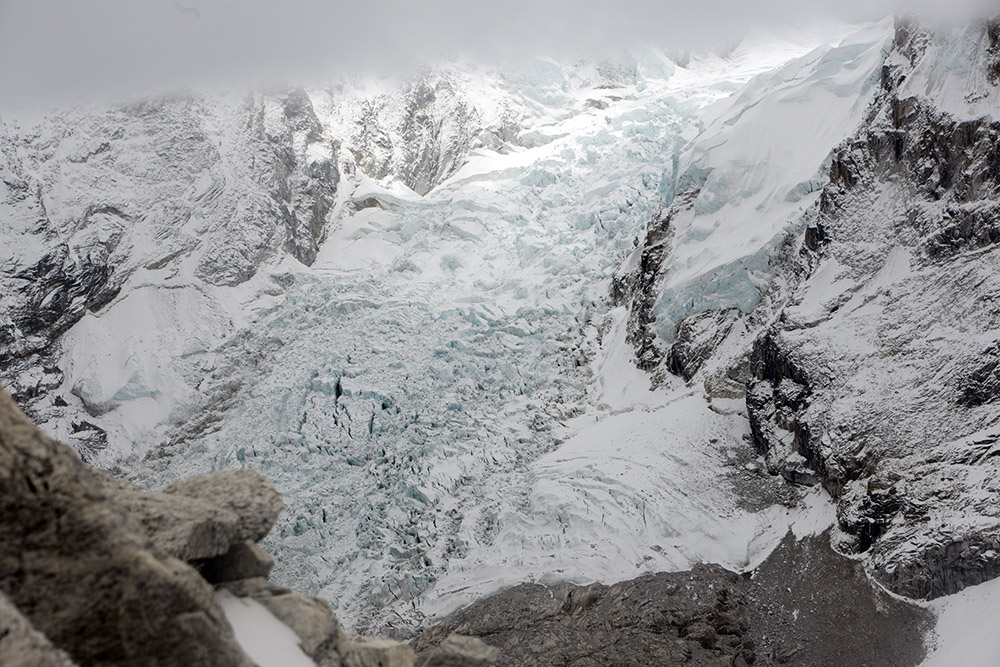
I took the photo below while standing near Pumori Base Camp at an elevation of around 19,500 feet (6,000 meters), and there doesn’t seem to be a much better vantage point of the entire icefall. For those who have never seen the icefall before, you might not know exactly what you’re looking at. The Khumbu Icefall is a constantly moving river of glacial ice. All that movement makes it highly unstable and dangerous.
There is simply no practical way to approach Everest’s normal south-side route without passing through it. The icefall begins in the lower left part of the photo and rises toward the upper right, climbing from roughly 17,500 feet (5,300 meters) near Base Camp to around 19,500 feet (6,000 meters) near Camp I.
The icefall is right outside Base Camp. As big as Base Camp is though, the entrance could be anywhere from a five- to thirty-minute walk depending on where your expedition is located. Generally climbers leave for the icefall late at night or very early in the morning.
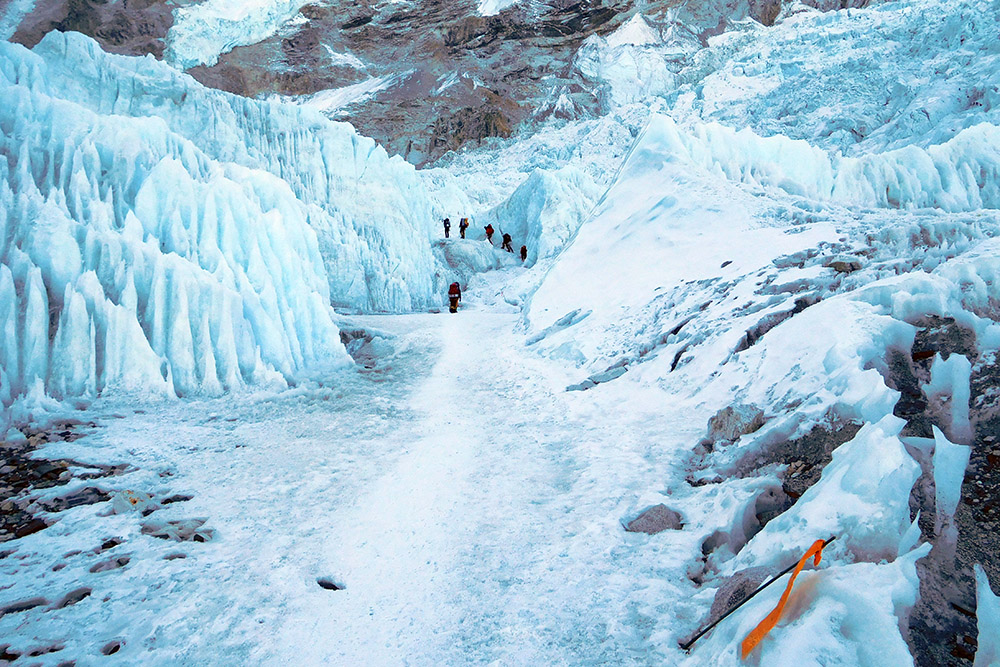
The ice is generally more stable during the colder hours, but anything can happen. I actually made four trips through the icefall as I went up and down the mountain to acclimatize. Only once did I go up at night. The other times were very early in the morning or in daylight. Below you can see some of us returning to Base Camp at the very end of the icefall.
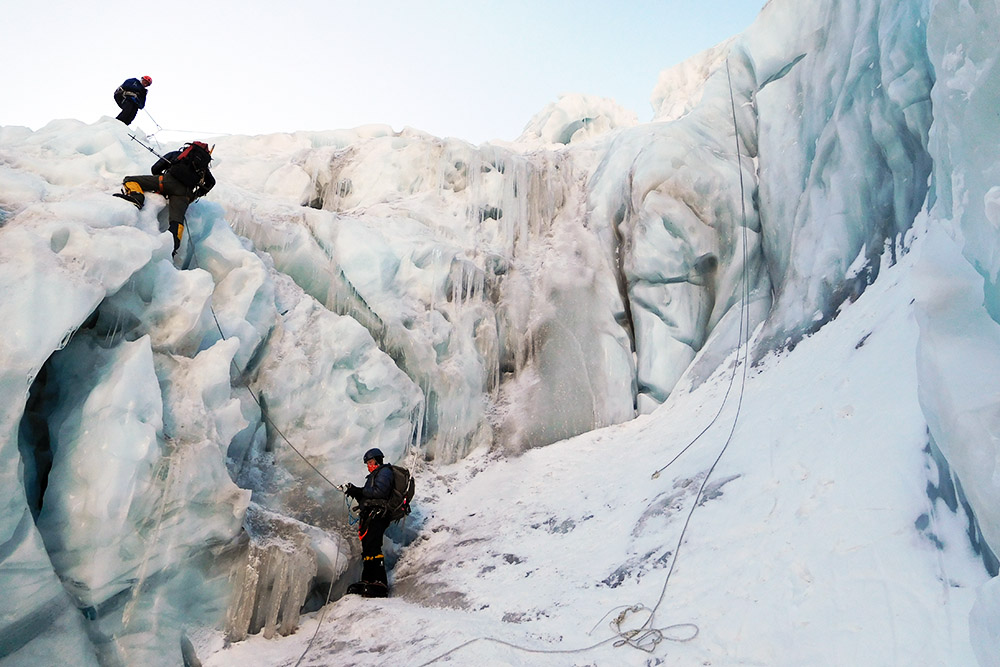
Since the icefall is constantly moving, it is obviously always changing. Parts that you have to ascend, like in the photo above, might be completely different or not even exist the next time you return.
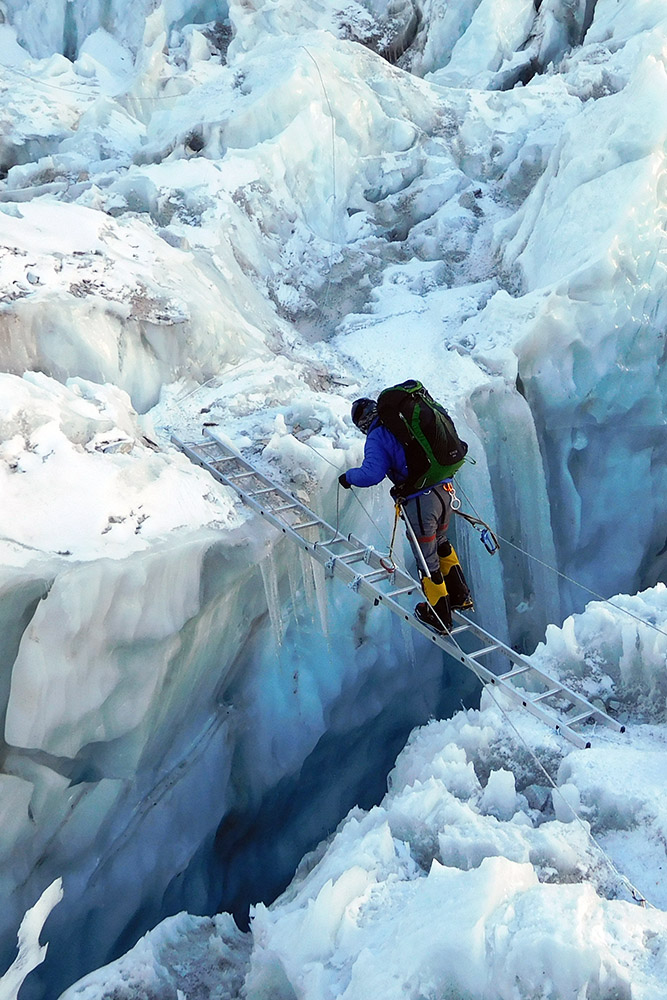
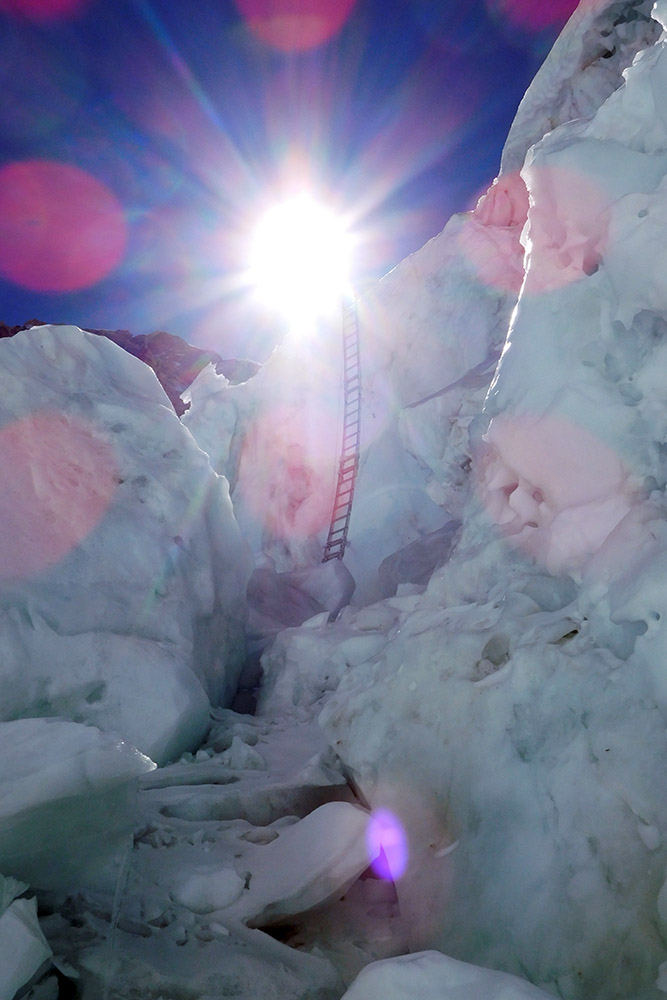
The icefall is famous for the use of ladders to cross open crevasses and sections of vertical ice. This ladder above was the very first one that I crossed while in the icefall. The vertical one below was the second.
I should also mention that by chance I saw my expedition leader from Denali coming down the vertical ladder for the first time in six years! The first crevasse in my photo above seemed to remain throughout my expedition, while other crevasses suddenly opened and required new ladders to be installed.
Because the icefall is such an unstable environment, the route constantly needs to be checked and adjusted. Instead of every expedition trying to maintain its own route, a dedicated Sherpa team known as the Icefall Doctors installs and maintains the ropes and ladders through the icefall. It’s an extremely dangerous and demanding job.
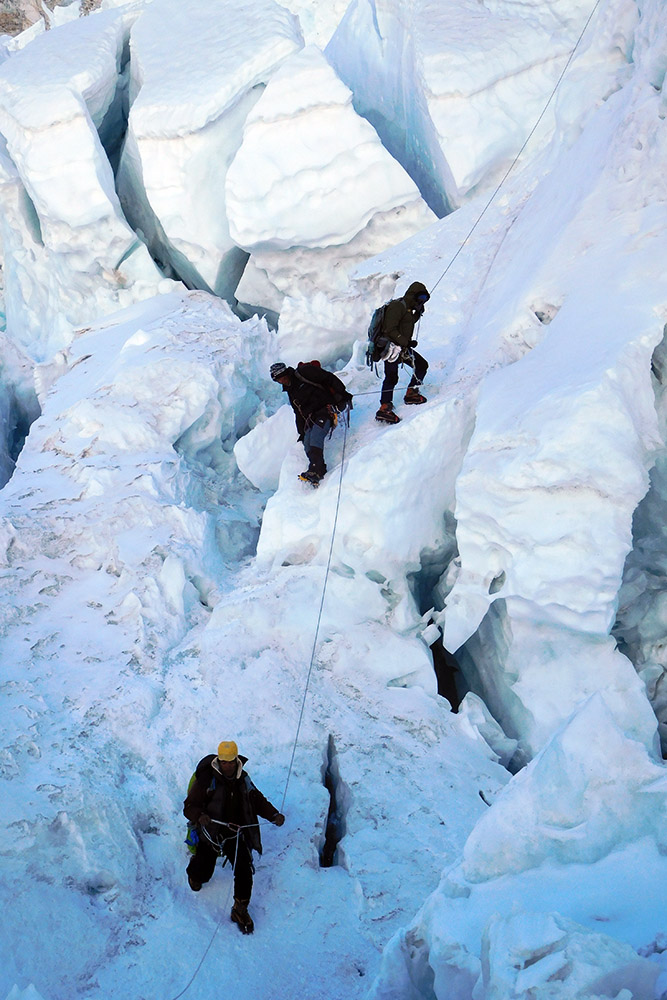
Here’s a photo of some climbers descending the icefall. Sometimes this place can be crowded, but I climbed during a season with fewer climbers than normal, so I rarely had to wait on anyone. Often I didn’t see anyone at all and felt like I mostly had the icefall to myself!
Crossing the Khumbu Icefall has always required an enormous amount of work to establish a route through the moving glacier. Modern climbers have the Icefall Doctors and aluminum ladders, while the early Everest expeditions used more primitive methods to cross the crevasses and negotiate the ice.
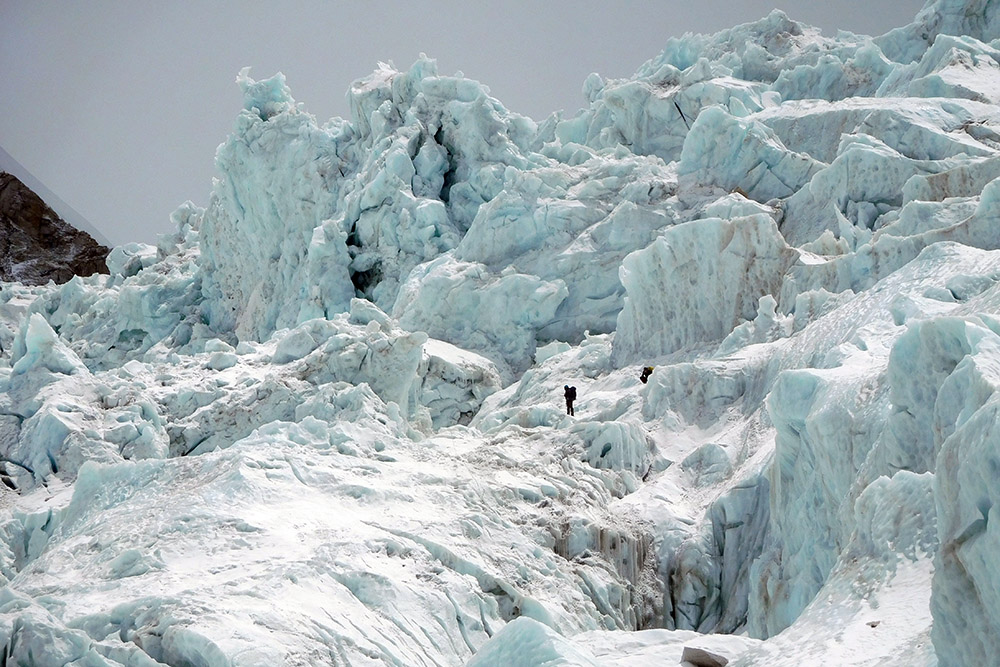
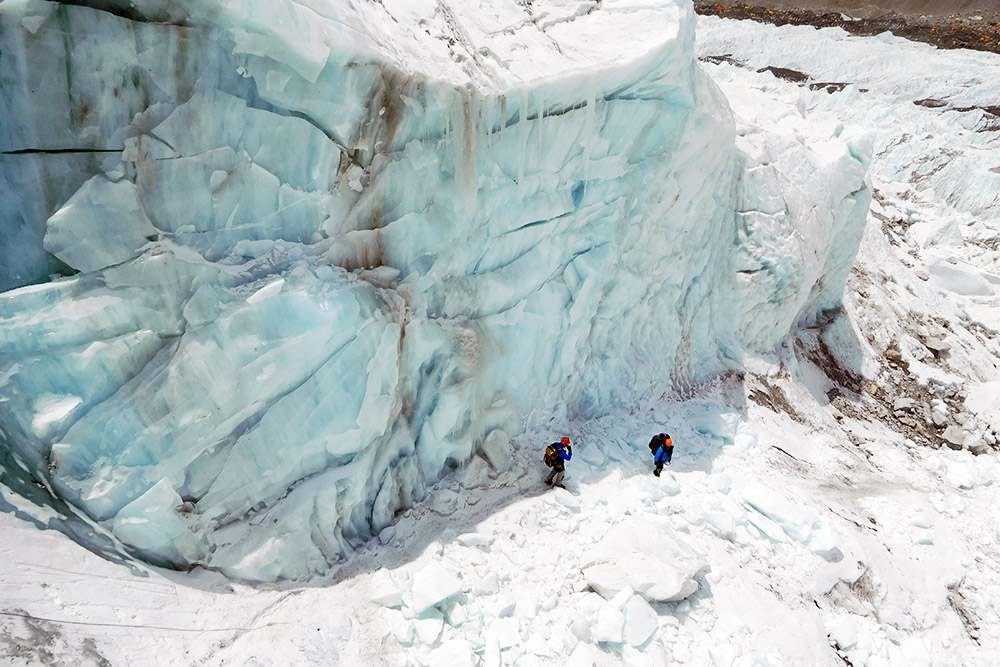
It’s difficult to get any perspective of the icefall without people in the photos. Here you can see how small these two climbers look beneath the giant ice seracs. Remember that the ice here can break without warning, and getting crushed by a collapsing serac is a serious risk. My first time going up the icefall I heard a piece of ice crack, and just that alone was incredibly scary.
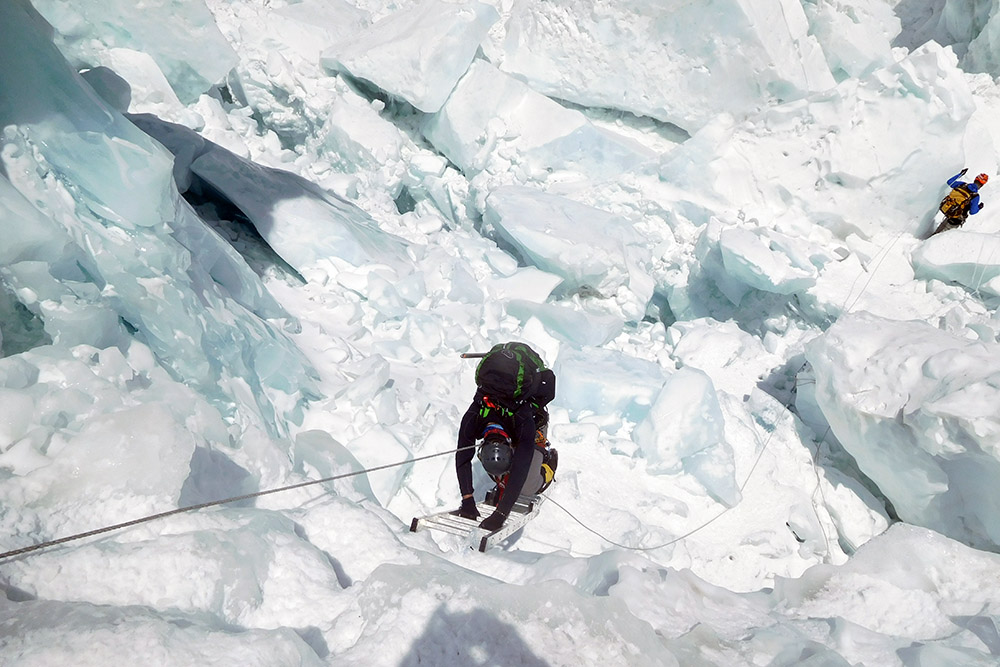
Below is a photo of myself going down a small vertical ladder in the middle of the Khumbu Icefall.
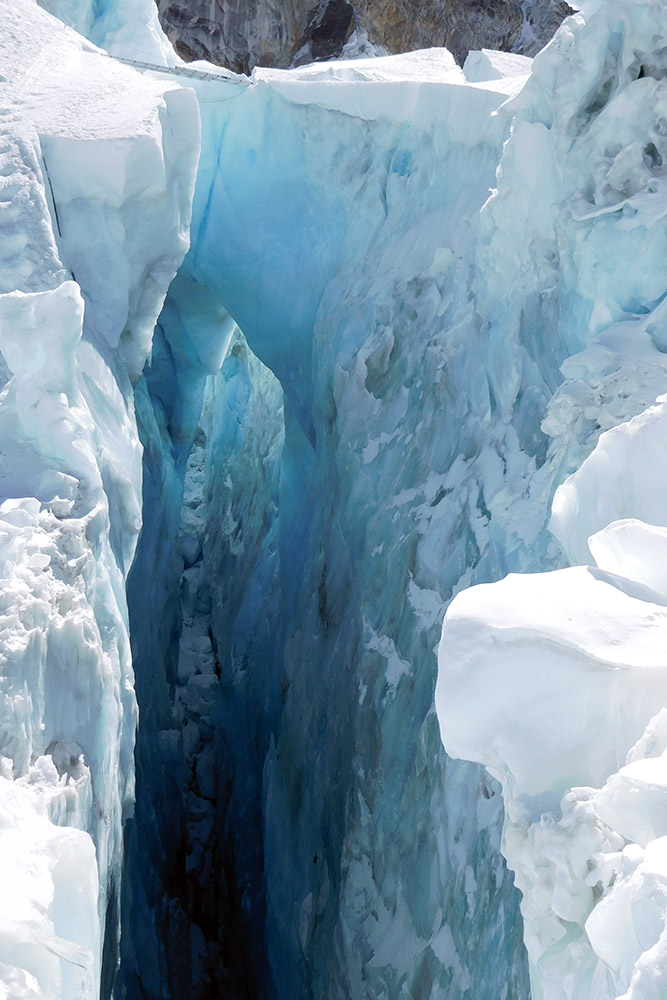
People always ask me how deep the crevasses in the icefall are. Every one of them is different, but this photo gives you an idea of how deep they can be. At the very top of the photo above you can barely see a small ladder crossing the crevasse.
Although crossing the ladder itself isn’t too bad, the frightening part is knowing that the edges of the crevasse are made of unstable ice. You’d have to be incredibly unlucky to be on a ladder during a major collapse, but in the Khumbu Icefall it is always a possibility.
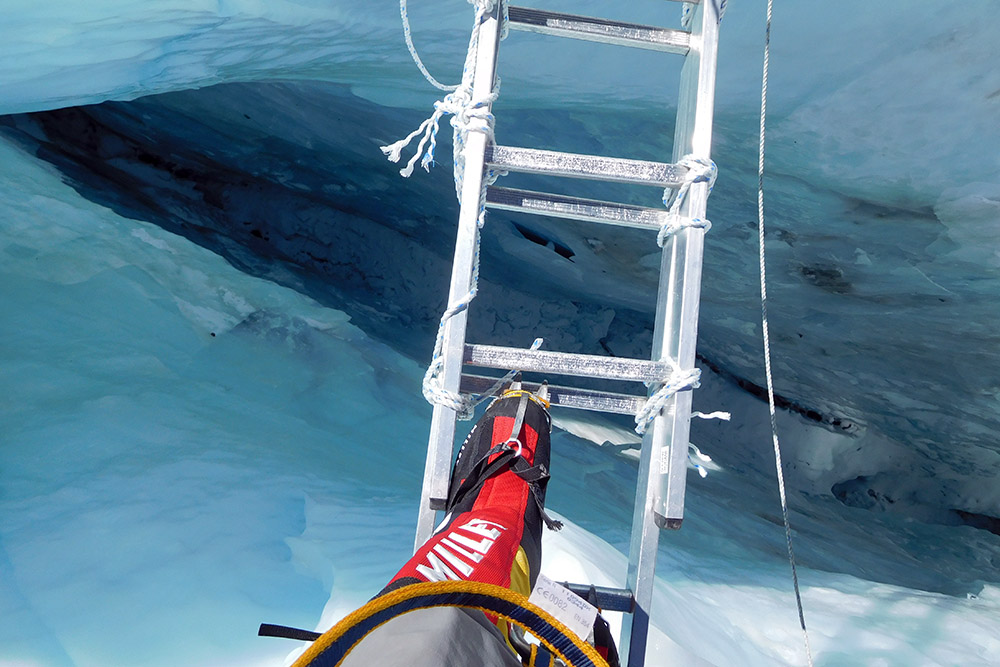
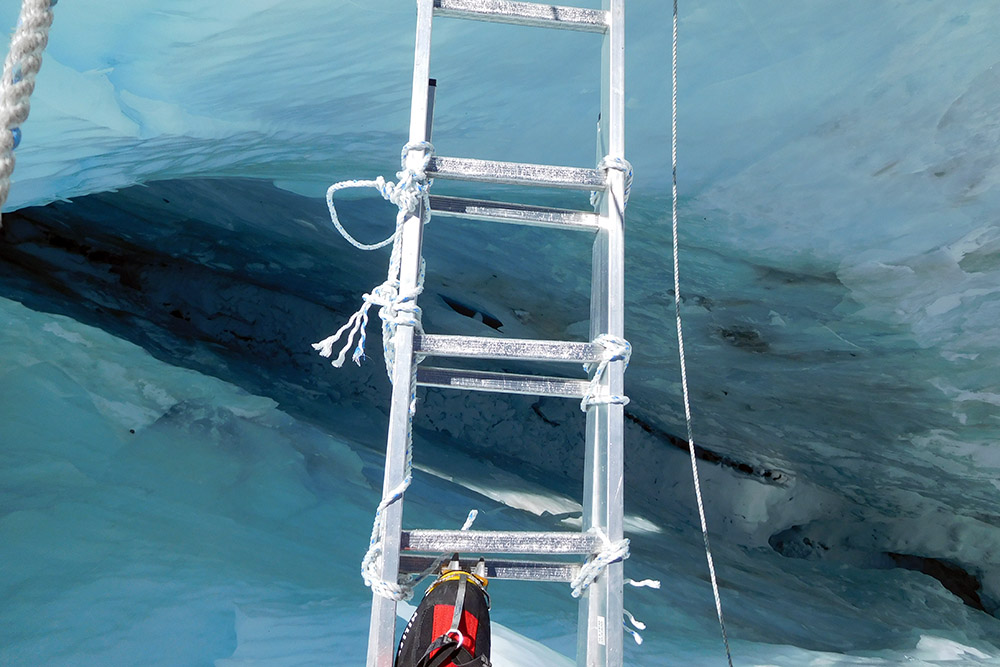
The photo above is a shot I took while crossing over the giant crevasse. I found the horizontal ladders to be one of the most uncomfortable parts of the entire climb. Crossing a ladder with crampons on felt very unnatural. On top of that, the ladder felt unstable, leaving you feeling highly exposed.
On most other parts of the mountain, I felt secure when I was clipped to a rope, whether I was ascending or rappelling. Here there was an honest chance of slipping off the ladder and ending up dangling in the air from your safety line.
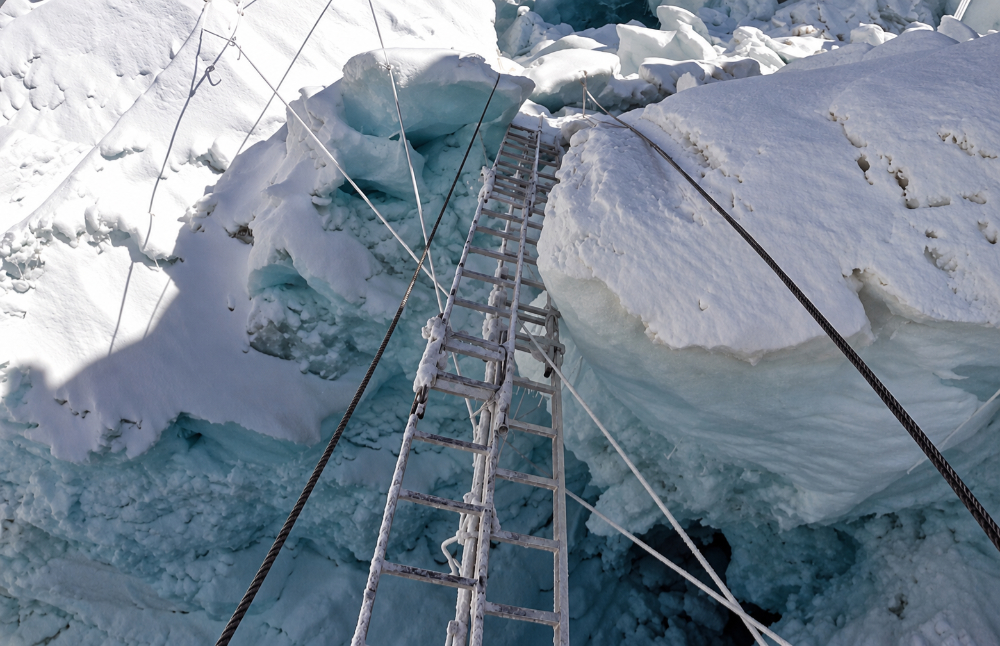
Despite not liking the ladders, this double one was actually my favorite. The scary part about this crevasse is that it did not exist when we first went up through the icefall. One night in Base Camp the icefall suddenly split open here, temporarily trapping climbers above the new opening. It was so loud that it woke me up in the middle of the night.
This was by far the longest horizontal ladder crossing we had, but somehow it felt safer to me because the crossing was reinforced with multiple ladders.
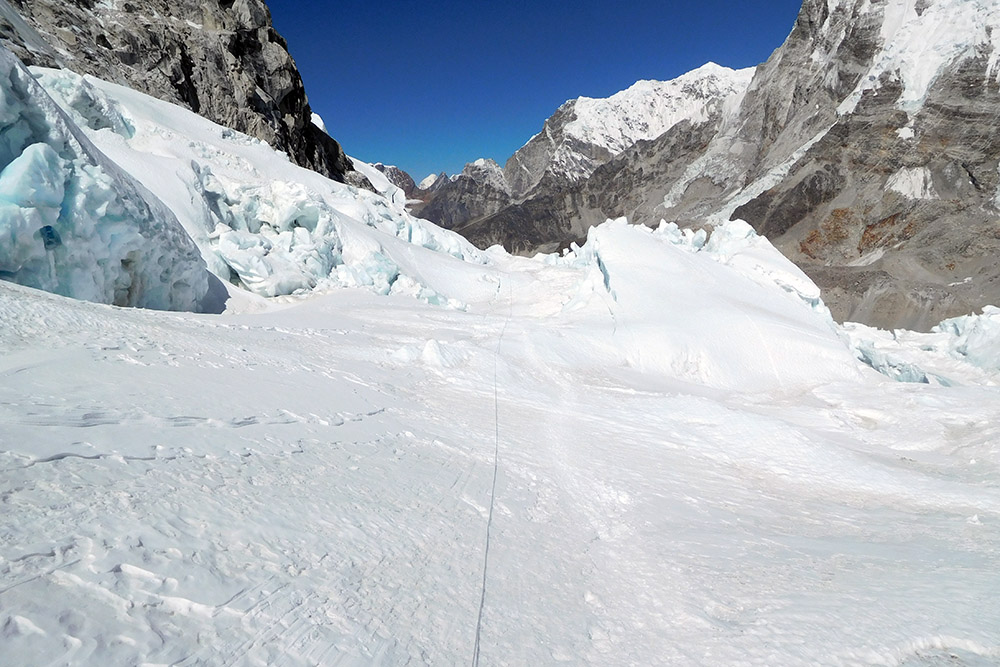
Right in the center of the icefall was this flat and peaceful area. It was a perfect place to stop for a break, which we did on both our way up and down the icefall.
The last time I came down the icefall on my way home, this area was completely destroyed. Normally we hiked straight ahead following the rope you see in the photo. When I came back down, there was nothing but a big pit here filled with jagged boulders of ice.
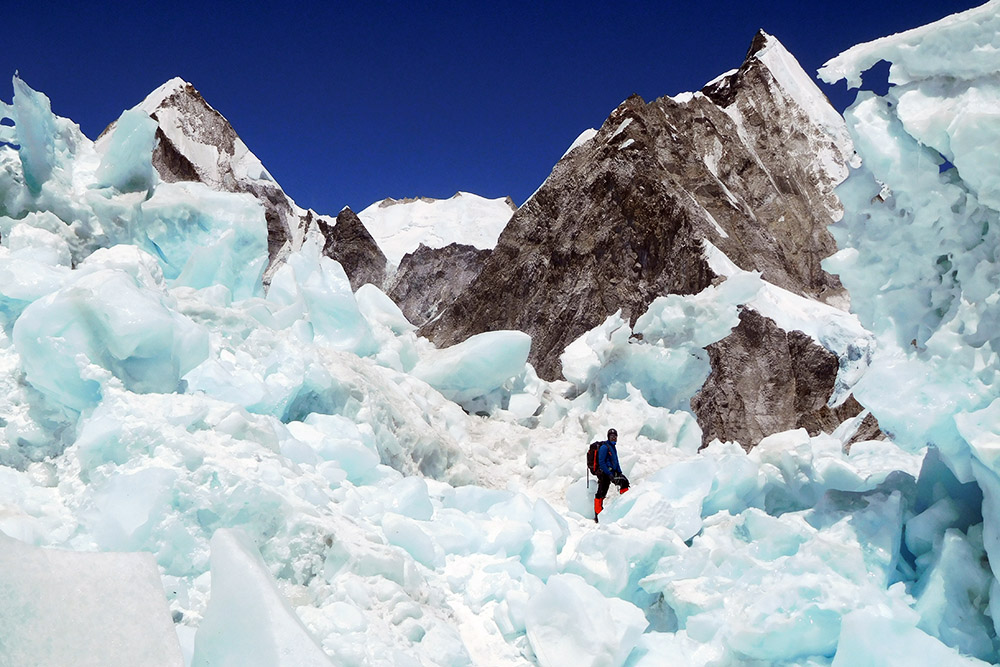
The second half of the icefall isn’t too different from the bottom, although I remember there being fewer ladders. This photo above shows the upper end of the icefall close to 19,500 feet (6,000 meters).
The first time I went up through the icefall I loved every step of it. It was on my way back down that my opinion changed. I passed beneath a giant piece of ice when it suddenly started rumbling. It was incredibly loud, and I seriously thought it was going to collapse on me. I honestly believed I might die at that moment, and when nothing happened I got away from it as quickly as I could.
Someone who had been above me later told me he saw a large crack go through the giant piece of ice but stop halfway. After that experience, I dreaded the idea of returning here and even thinking about it became stressful.
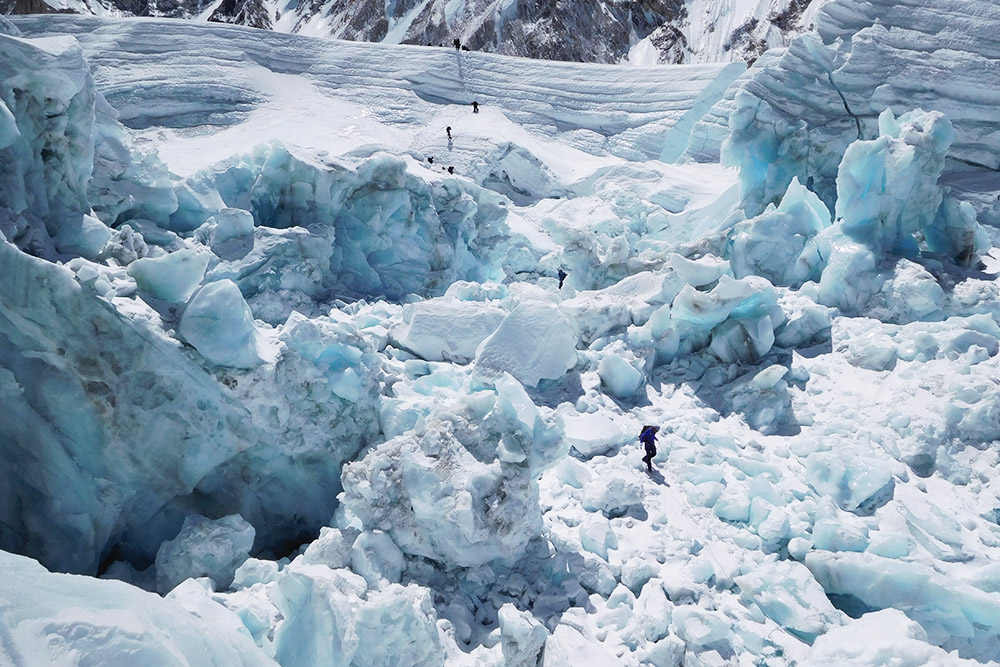
I personally felt that the upper part of the icefall was the most dangerous section. This photo shows the end of the icefall as I approached it for the first time. Once you climb that final section, you’re basically through it and on your way toward Camp I.
Anything can happen anywhere along the route, but the huge blocks and seracs in this upper section made me especially uncomfortable. Another climber on my expedition also saw a large serac collapse in this area and disliked the icefall so much that he eventually took a helicopter back down rather than pass through it again.
The photo below shows me rappelling down into the upper entrance of the icefall as I headed back toward Base Camp after spending more than a week acclimatizing higher on the mountain.