Bolivia was one of the most distinctive countries I visited in South America. Although it is one of only two landlocked countries on the continent, the landscapes changed dramatically as I traveled, from high-altitude cities and the Andes to Lake Titicaca, enormous salt flats, volcanoes, and desert.
What stood out just as much was Bolivia’s strong Indigenous heritage. Indigenous languages, traditions, clothing, and culture were much more visible in everyday life than in many other places I had traveled. Combined with the country’s ancient archaeological sites and extraordinary geography, it gave Bolivia an identity that felt distinctly its own.
My travels took me through La Paz and the ruins of Tiwanaku, along the shores of Lake Titicaca, across the seemingly endless Salar de Uyuni, and eventually into the remote landscapes of southwestern Bolivia. In a relatively short distance, I experienced some of the greatest contrasts of anywhere I traveled in South America.
Explore La Paz
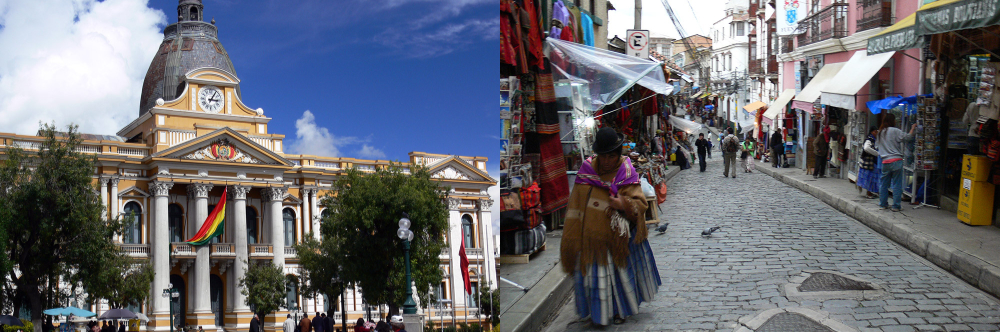
Set dramatically among the Andes, La Paz is one of the world’s highest major cities, with the surrounding metropolitan area spreading across an enormous range of elevations. Mountains and steep-sided valleys form a spectacular backdrop to a dense city where buildings climb seemingly every available slope.
La Paz is also one of Bolivia’s major centers of Indigenous culture. Traditional markets, distinctive neighborhoods, historic streets, and the famous Mercado de las Brujas, or Witches’ Market, make the city an introduction to both modern Bolivia and traditions with much deeper roots.
Explore Tiwanaku
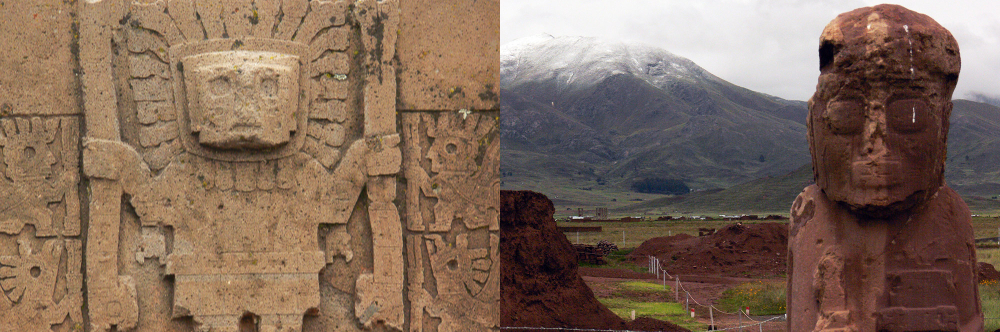
About 70 kilometers west of La Paz are the remarkable ruins of Tiwanaku, the former capital of a powerful pre-Hispanic civilization that influenced a large area of the southern Andes. The city reached its height centuries before the rise of the Inca Empire and remains one of Bolivia’s most important archaeological sites.
Monumental stone architecture, carved figures, ceremonial spaces, and structures including the Akapana and Pumapunku complexes provide a glimpse into the sophistication of Tiwanaku society. The archaeological site was designated a UNESCO World Heritage Site in 2000.
Explore Lake Titicaca & Copacabana
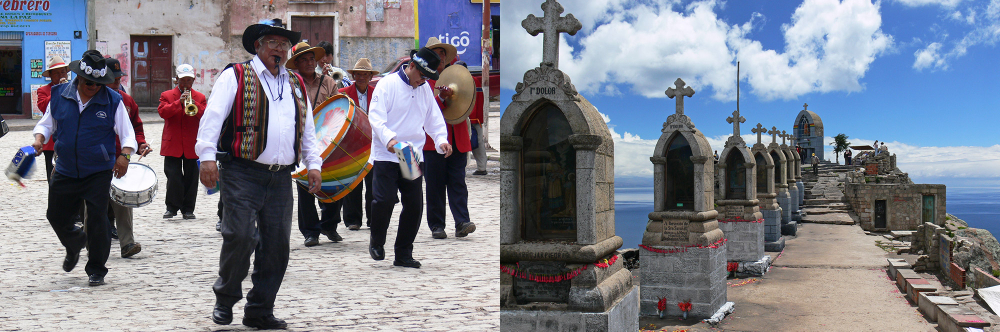
Lake Titicaca stretches across the border between Bolivia and Peru at roughly 3,810 meters above sea level, creating an immense expanse of deep-blue water surrounded by the Andes. Communities and civilizations have flourished around its shores for thousands of years, giving the lake enormous cultural as well as geographic significance.
On the Bolivian shore, Copacabana is one of the country’s best-known lakeside towns and a gateway to the islands and archaeological sites of Lake Titicaca. The combination of high mountains, ancient history, Indigenous culture, and vast open water makes this one of Bolivia’s most distinctive regions.
Explore Salar de Uyuni
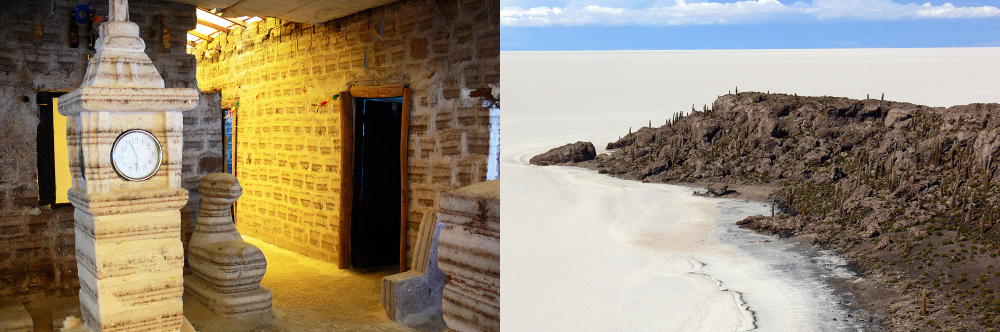
Salar de Uyuni is the largest salt flat in the world and one of South America’s most surreal landscapes. Its immense white surface stretches toward the horizon, interrupted by islands covered with giant cacti and surrounded by distant volcanoes.
Multi-day 4×4 journeys across the salt flats continue into the remote landscapes of southwestern Bolivia, passing volcanoes, deserts, lagoons, and geothermal areas. Even the accommodations can be unusual, including hotels constructed largely from blocks of salt.
Explore Eduardo Avaroa National Park
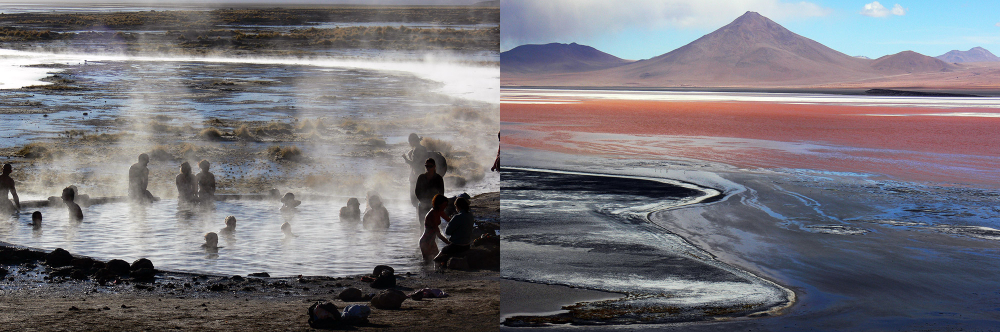
In the extreme southwest of Bolivia, the Eduardo Avaroa region contains some of the country’s most extraordinary high-altitude scenery. Volcanoes rise above barren deserts, geothermal fields send steam into the thin Andean air, and flamingos gather in remote lagoons surrounded by mountains.
The region is especially famous for its brilliantly colored lakes. Minerals, algae, and other natural processes produce vivid reds, greens, blues, and whites, creating landscapes unlike almost anywhere else in South America.