Mount Elbrus is the highest mountain in Europe, reaching 18,510 feet (5,642 meters). Climbing Elbrus is similar in some ways to Kilimanjaro, but the mountain requires a step up in technical equipment. Instead of normal hiking and camping gear, Elbrus requires mountaineering boots, crampons, an ice axe, and the ability to travel safely over glaciated terrain.
The year I climbed Elbrus, several people had died on the mountain. Elbrus generally wouldn’t be considered a dangerous mountain, as the route it straight forward, cold is moderate, altitude isn’t very high, but any glaciated peak should still be taken seriously. Like Mt. Blanc, the mountain’s accessibility brings lots of climbers, some of whom don’t show up prepared. A tragic accident occurred the year before I climbed, where eight climbers slid to the deaths.
Every outdoor challenge should be taken seriously, especially a glaciated peak rising above 5,000 meters. Somewhere halfway up this mountain, I was essentially learning what crampons, an ice axe, and crevasses were. My own lack of experience exposed me to dangers I didn’t fully understand at the time. To this day, Elbrus probably remains the closest I’ve ever come to killing myself on a mountain.
Before I talk about the actual climb, there is one geographical argument surrounding Elbrus worth mentioning: Is it really the highest mountain in Europe?
The answer depends on where the boundary between Europe and Asia is drawn through the Caucasus. Under the convention that places the continental boundary along the watershed of the Greater Caucasus, Elbrus lies on the European side and is Europe’s highest mountain. Under alternative definitions that place the boundary farther north, Mont Blanc would become Europe’s highest peak.
The convention recognizing Elbrus as European is the one generally used for the Seven Summits, and that’s the definition I followed. So seven years after climbing Kilimanjaro, I traveled to Russia to attempt my second of the Seven Summits.
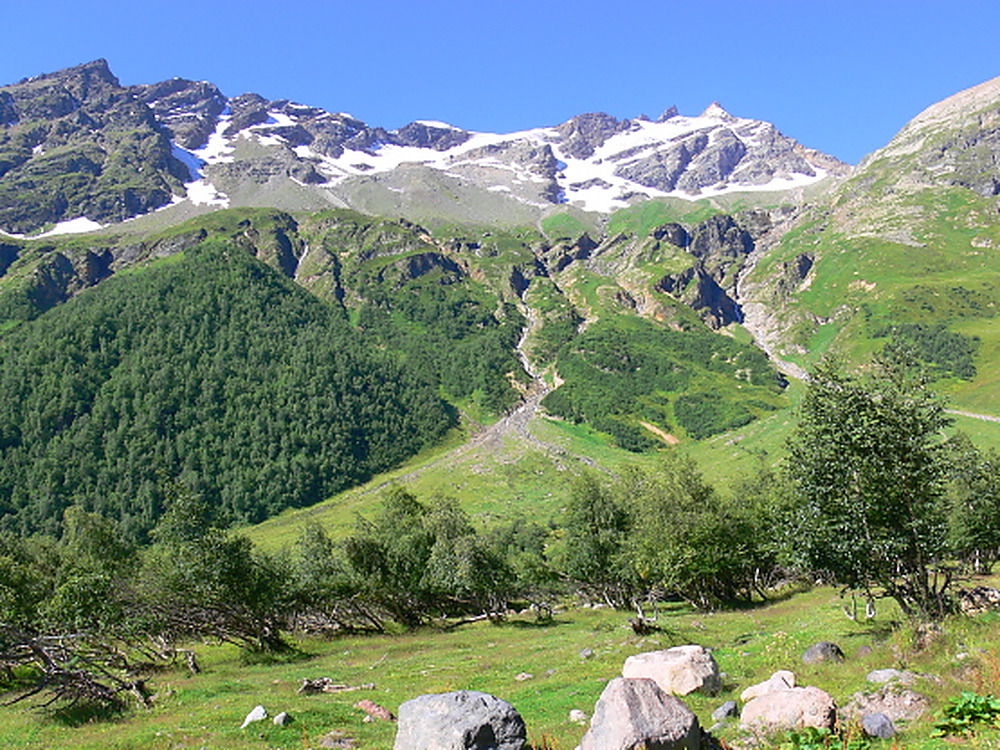
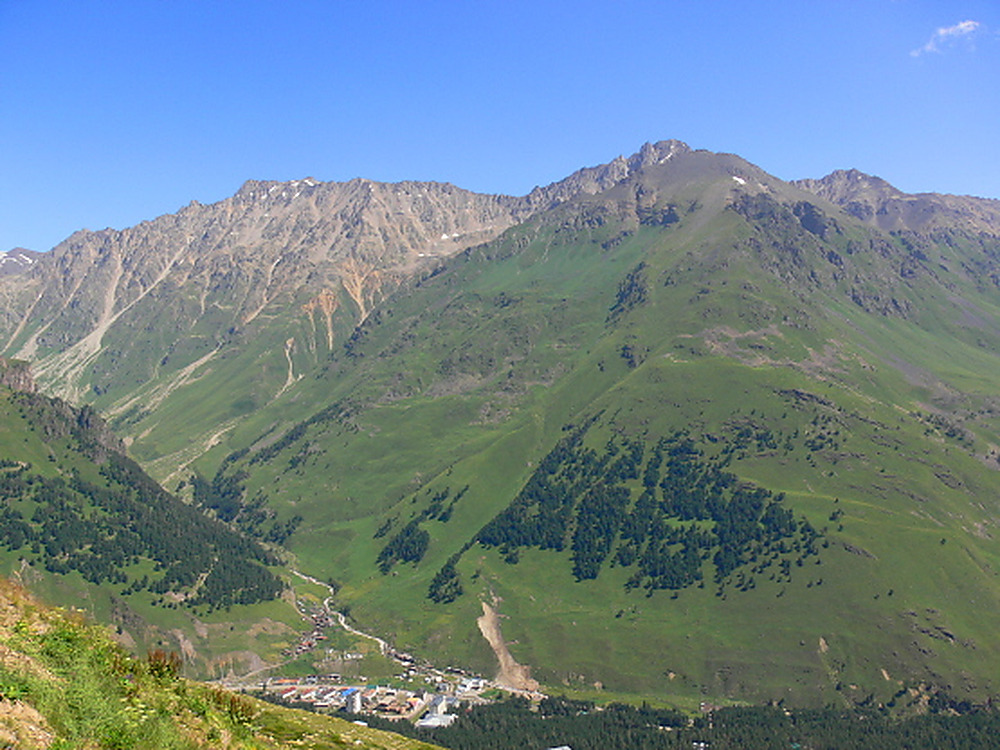
These were some of my first views of the Caucasus Mountains. I spent the night in a small village near Elbrus before beginning the climb.
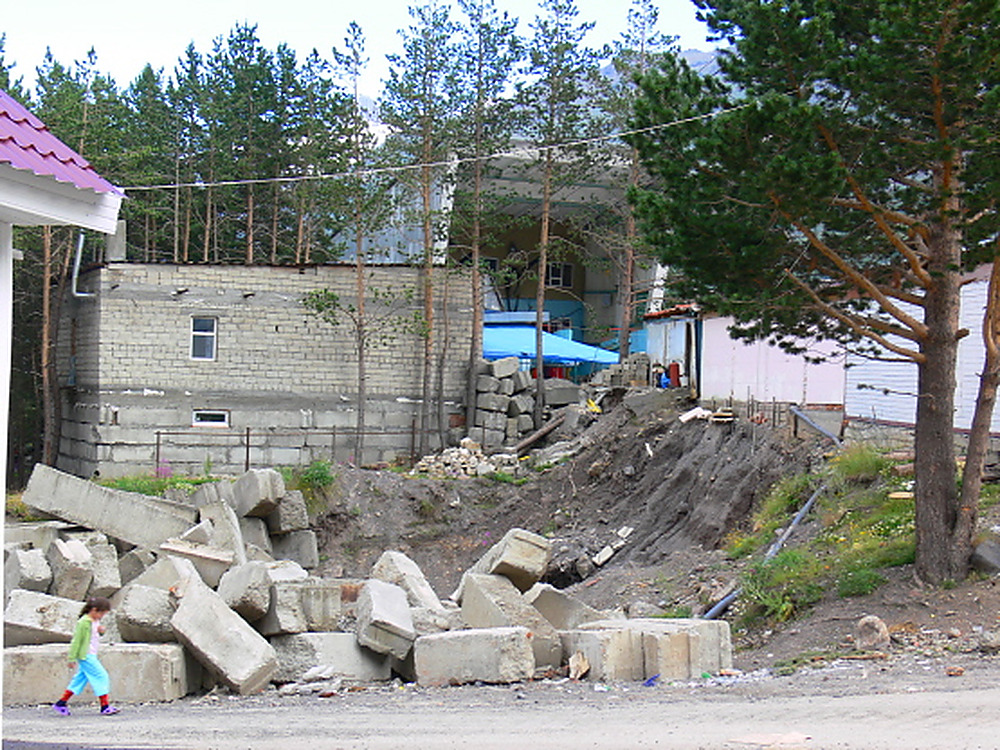
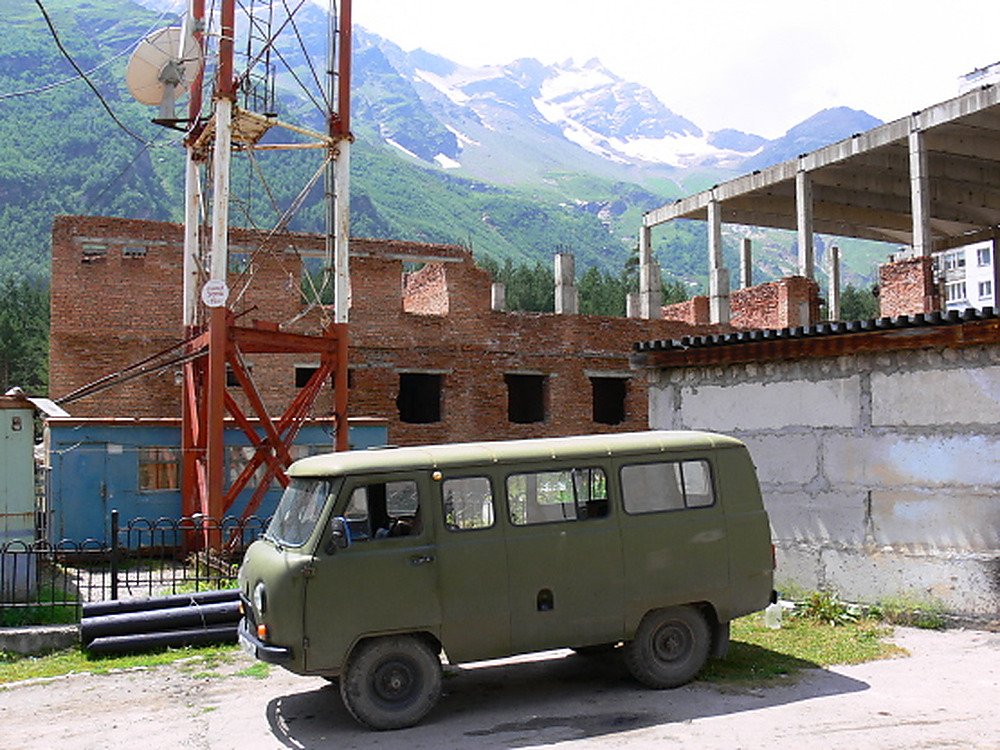
The town around Elbrus was small and didn’t have much that immediately attracted the eye. There were enough shops and smoky restaurants to eat at, though, and even an Internet cafe to keep me entertained for a few days.
English wasn’t widely spoken, and I wasn’t finding English menus or even many menus with photos. I also saw Russians training on what looked like roller skis, flying down the steep streets at incredible speeds. They appeared to be training seriously rather than just having fun, and I regret not taking any photos of them.
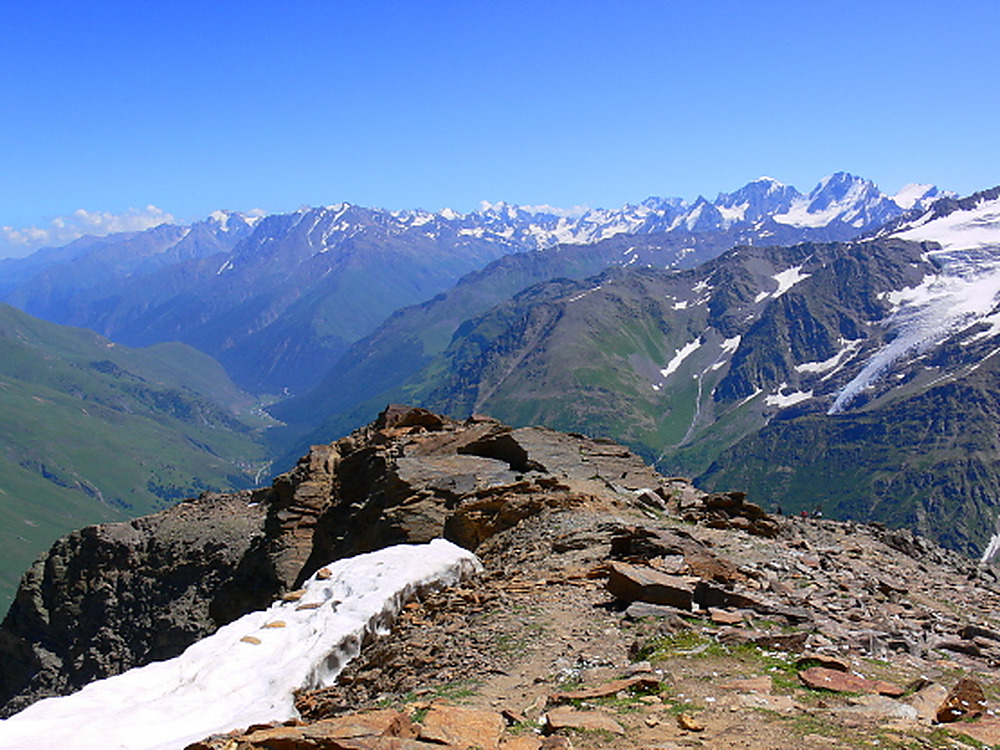
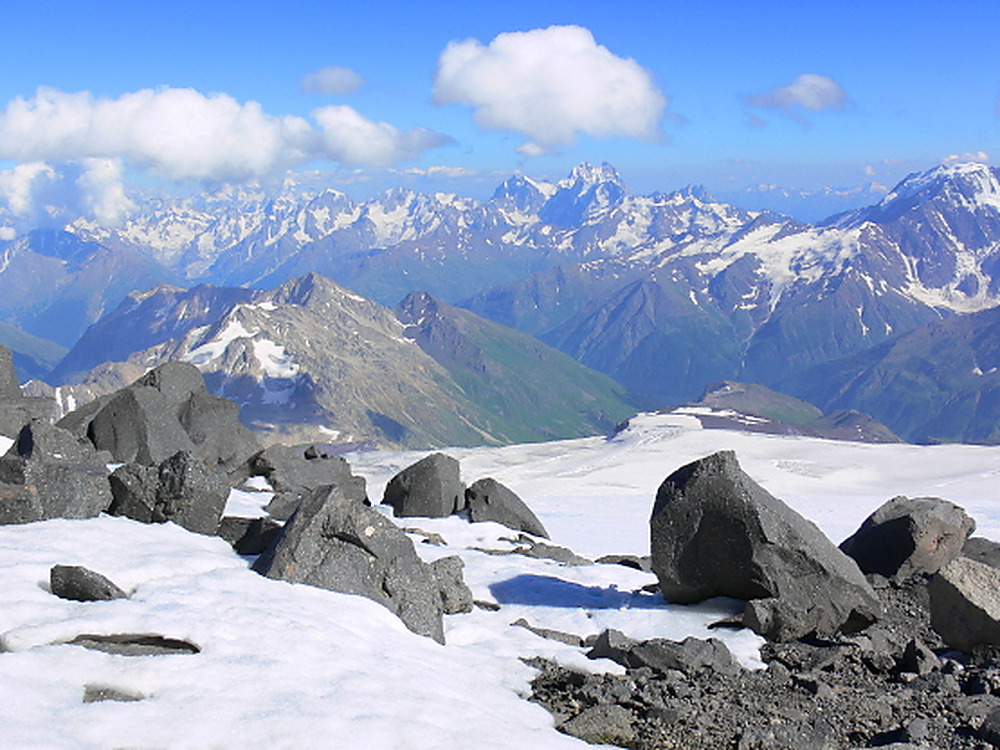
From town, we did several acclimatization hikes to prepare for the altitude. We were staying around 7,000 feet, but hiked high enough to reach the snow and get some beautiful views of the surrounding mountains.
When we finally moved onto Elbrus itself, ski lifts carried us to roughly 12,000 feet. We stayed in the famous barrel huts, which were quite literally barrel-shaped shelters on the mountain. They weren’t especially clean or comfortable, and the nearby outhouses weren’t exactly a highlight, but the huts were still better than sleeping in a tent.
The acclimatization hikes were challenging because of the altitude, but physically I felt strong. At that point, nothing seemed beyond what I had prepared for.
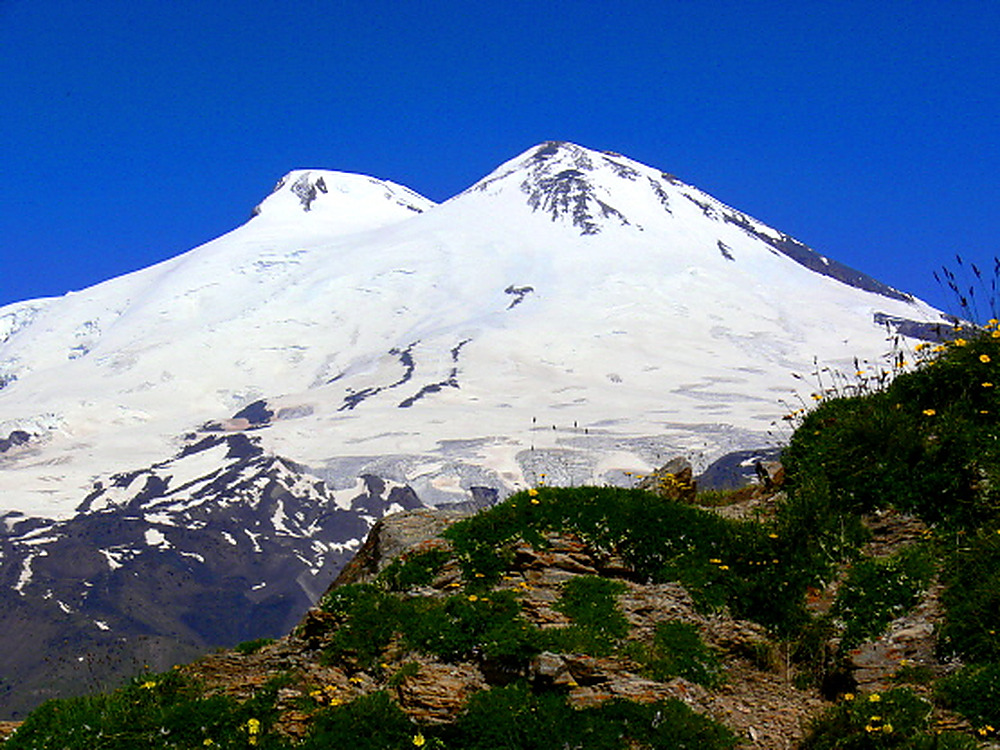
It was during one of these acclimatization hikes that I got my first great view of Mount Elbrus. From this angle, the western summit appears lower, but it is actually the mountain’s true and higher summit.
Once I was on the mountain, things began to get interesting for me, and not in a good way.
My problems actually began before I ever reached Elbrus. When I arrived in Moscow, my luggage was lost. I had just come from summer temperatures around 100°F in Washington, D.C., and suddenly found myself walking around Moscow in cold rain wearing a T-shirt. By the time I reached Elbrus, my nose was a waterfall and I couldn’t sleep for more than a few hours at a time.
Despite being sick, I felt surprisingly good whenever I was moving. The day before our summit attempt, our group descended from around 15,000 feet after an acclimatization hike. Everyone spread out and descended at their own pace.
I was hiking back toward camp alone when I eventually realized that a significant amount of time had passed without seeing anyone. There wasn’t a conventional trail because everything was covered in snow, but footprints made it fairly obvious where people had been traveling.
I continued following the tracks, but the longer I walked, the more I began questioning myself. Had the tracks split somewhere? Had I accidentally followed the wrong set? Was I walking farther and farther away from my camp?
Something else bothered me. From the barrel huts, Elbrus’s two summits appeared almost in line with each other. From where I was standing now, they seemed almost side by side. With the sun getting lower, I started worrying that I might be hours from camp.
That’s when I made a very bad decision.
Instead of staying on the established route, I decided to cut across a large snowy hill that appeared to lead toward where I thought camp should be. About half a mile above me was a Russian camp. I figured that as long as I could see people, I couldn’t really get lost.
My plan was simple: hike for about 20 minutes, look over the hill, and if I didn’t see my camp, turn around.
When I reached the other side, all I saw was white glacier. There were no visible tracks and no sign of my camp. I realized I had made a mistake and needed to backtrack.
Around this time, people at the Russian camp spotted me. They came toward me yelling, but they were too far away for me to understand what they were saying. Eventually they realized I didn’t speak Russian and shouted something I could understand:
“Go back! Go back!”
I misunderstood them. I thought they meant I shouldn’t continue in the direction I had been going, so instead I started walking toward their camp.
They became even more frantic.
Then one of my legs suddenly punched straight through the snow up to my hip.
I caught myself with my arms and my other leg stretched horizontally across the surface. Only then did I understand what everyone was trying to tell me.
I was standing in the middle of a crevasse field.
Before this trip, I had barely considered the danger of crevasses. I didn’t really understand what they were or how easily they could be hidden beneath snow. Now I had just discovered one using perhaps the worst possible method.
Had I fallen completely through, I could have been badly injured or knocked unconscious. If the people at the Russian camp hadn’t seen me, the chances of anyone hearing me or finding me quickly would have been terrible.
I pulled my leg out and looked into the hole. I couldn’t see the bottom.
I took out my ski pole and began probing the snow around me. In many places, the pole went effortlessly through the surface. I spent roughly 20 minutes carefully probing and zigzagging my way back toward safer terrain. At one point, I even had to cross a long narrow opening in the glacier.
The entire time, about a dozen people stood on the rocks above watching me make my way out.
Once I finally reached the Russian camp, everyone was incredibly nice to me. They gave me food and explained just how dangerous the area I had wandered into was.
They also gave me vodka.
Lots of vodka.
They asked me to stay the night, and I didn’t want to be rude when they began making toasts. Before I knew it, we’d gone through about five of them and I was pretty buzzed at 14,000 feet.
I didn’t mind staying there, but a member of my group eventually arrived. Everyone back at my camp had been searching for me. I had repeatedly tried asking the Russians whether my group knew where I was, and they had apparently misunderstood what I was asking.
Back at my own camp, my guides decided that surviving the incident required another celebration.
Which meant more vodka.
The incident might sound almost funny looking back at it, but it wasn’t. People had died on Elbrus shortly before my climb, and the mountain had already demonstrated how quickly a simple mistake could become serious. I was disappointed in myself for giving Elbrus such an easy opportunity to add me to its toll.
The lesson was simple: don’t leave the established route on a glacier when you don’t know what you’re doing. Getting lost was a problem. Trying to solve that problem by wandering across unexplored glaciated terrain nearly created a much bigger one.
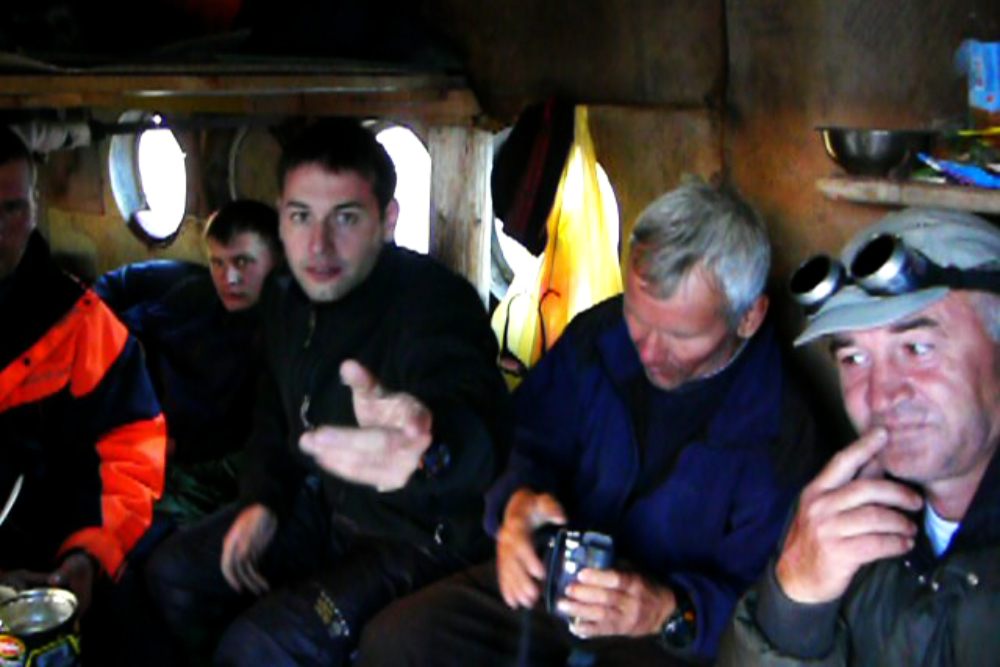
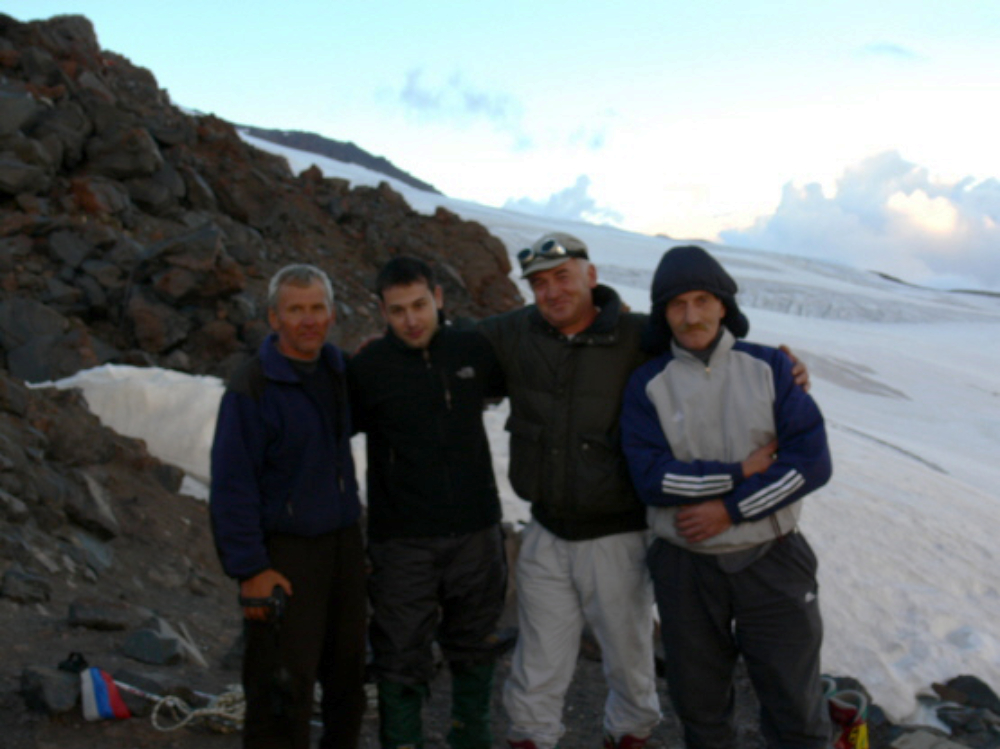
I appreciated the vodka and hanging out with everyone at the Russian camp, but drinking immediately before summit day was definitely not part of my original plan.
The next day I woke up at 12,000 feet physically exhausted, still sick, sleep deprived, and now slightly hungover. I also hadn’t eaten enough the previous day and had walked considerably farther than necessary.
During the summit climb, I remember being given an orange as part of my food. Peeling an orange above 15,000 feet (4,500 meters), with a hangover, a cold, almost no sleep, and complete exhaustion, was about the last thing I wanted to do. I didn’t even have enough energy to eat it, so I put it back in my pack.
During one of our breaks, I lay down and nearly drifted off to sleep. Somehow I felt completely relaxed despite how terrible I felt physically. Someone abruptly woke me and told me it was time to keep pushing toward the summit.
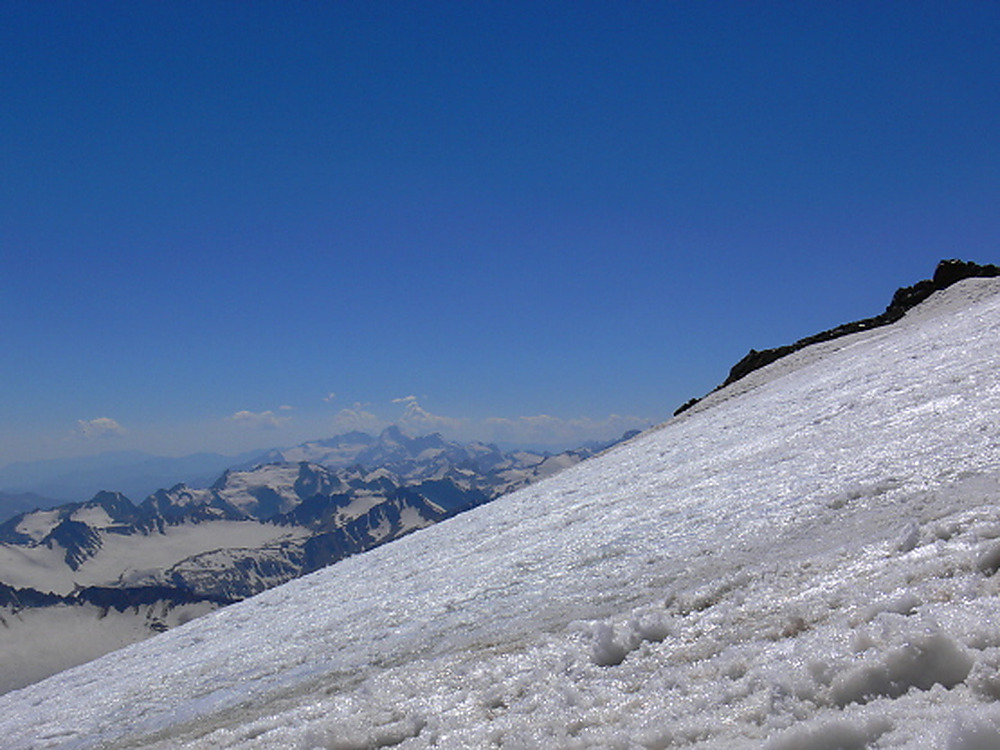
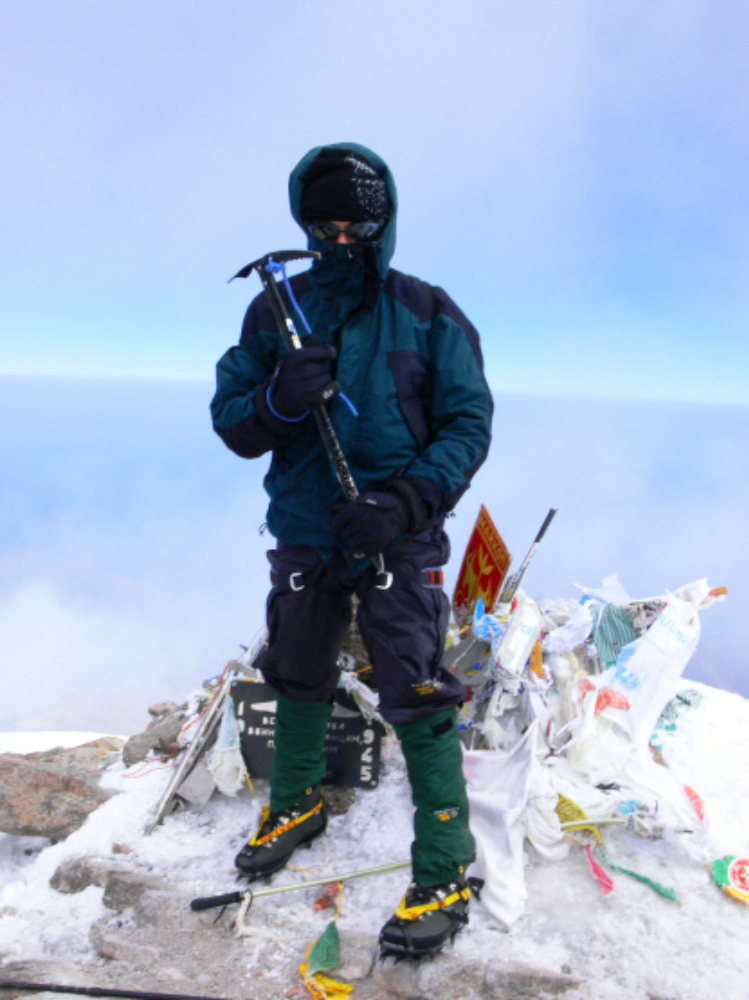
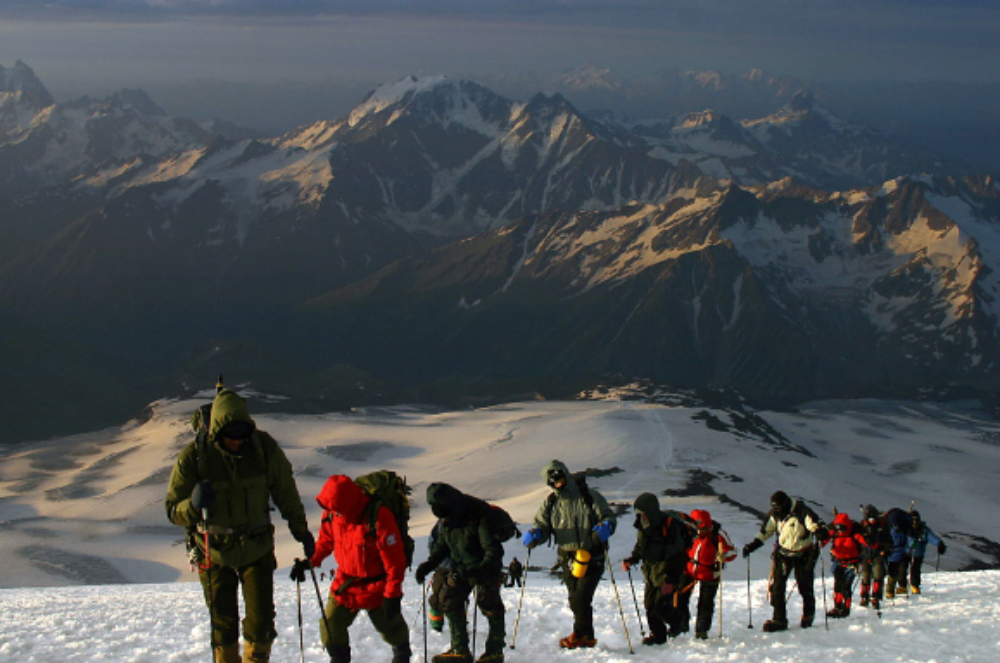
The photo above is one of the very few I took on the way to the summit. At higher altitude, taking pictures becomes surprisingly inconvenient. You have to stop, get the camera out of your pack, expose your hands to the cold, and potentially make the rest of the group wait. I became much better at photographing expeditions later, but on Elbrus I took very few pictures.
On August 8, 2006, I dragged myself onto the summit of Mount Elbrus and stood on top of Europe.
At that point in my life, reaching the summit was by far the hardest physical thing I had ever done. When I finally returned to the barrel huts, I remember telling myself in the strongest possible terms: never, ever, ever climb another mountain.
If I had possessed some supernatural ability that day to permanently prevent myself from mountaineering again, I wouldn’t have hesitated to use it. The best I could do was try to convince my future self, who I suspected might eventually forget how miserable I had been and once again become attracted to adventure and challenge.
My suspicions were correct.
Two years later, in 2008, I climbed another of the Seven Summits, Aconcagua. The following year I climbed Denali, and in 2011 I completed my fifth Seven Summit when I climbed Carstensz Pyramid.
