Bhutan is a small Himalayan kingdom known for its dramatic mountain scenery and extraordinary preservation of tradition. More than 70% of the country remains forested, with deep valleys separating high ridges and snow-capped peaks. Its constitution requires at least 60% of the country to remain under forest cover, and Bhutan has become internationally known as a carbon-negative country.
What stood out to me most was how different Bhutan felt from almost anywhere else I’ve traveled. Monasteries and massive dzongs dominate the landscape, traditional architecture is everywhere, and the country has made a deliberate effort to preserve its culture and natural environment while modernizing on its own terms. Tourism is also carefully managed, helping protect the landscapes and traditions that make Bhutan so distinctive. It is definitely one of the most unique countries I’ve ever traveled to!
Explore Thimphu
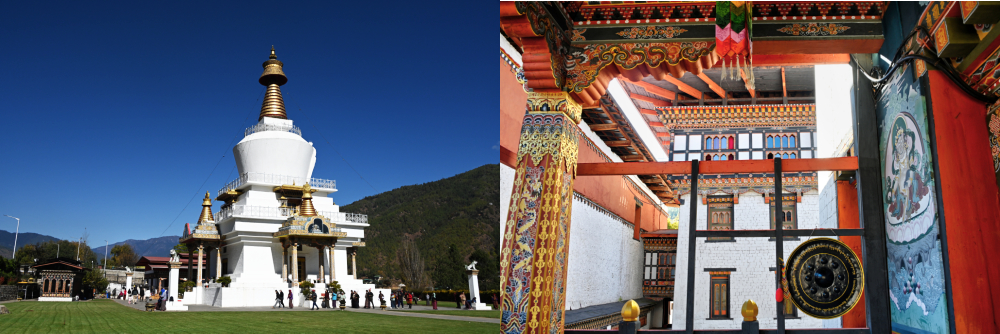
Thimphu is Bhutan’s capital and largest city, set in a narrow Himalayan valley along the Wang Chhu River. With a population of just over 100,000, it remains remarkably compact for a national capital and serves as the country’s political, administrative, and economic center.
Traditional Bhutanese architecture remains prominent throughout the city, alongside monasteries, markets, government buildings, and the imposing Tashichho Dzong. Surrounded by forested mountains, Thimphu offers an unusual combination of a modern capital and the architecture, religion, and landscapes that define Bhutan.
Explore Paro
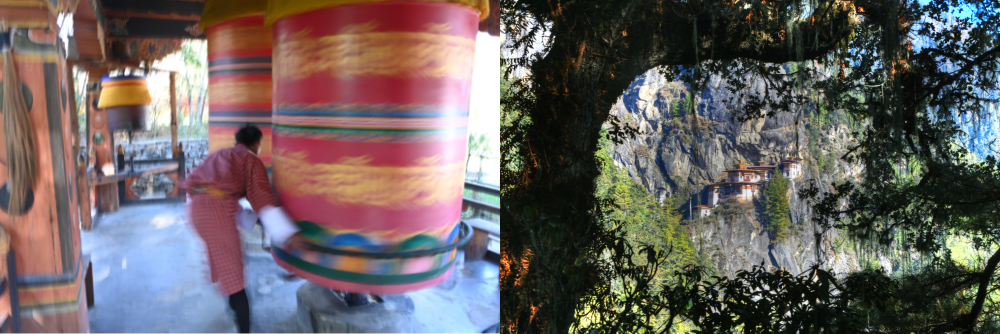
Paro is one of Bhutan’s most important historic towns and the country’s principal international gateway. Its airport sits in a broad mountain valley surrounded by forests, rivers, traditional homes, and farmland, creating a memorable introduction to the Himalayan kingdom.
The Paro Valley is filled with monasteries, temples, traditional villages, and historic fortresses, but its most famous landmark is Paro Taktsang, better known as the Tiger’s Nest Monastery. Perched dramatically against a cliff high above the valley, it has become one of the defining images of Bhutan. Beyond the monastery, Paro retains a quiet rural character dominated by mountains and countryside.
Explore Punakha
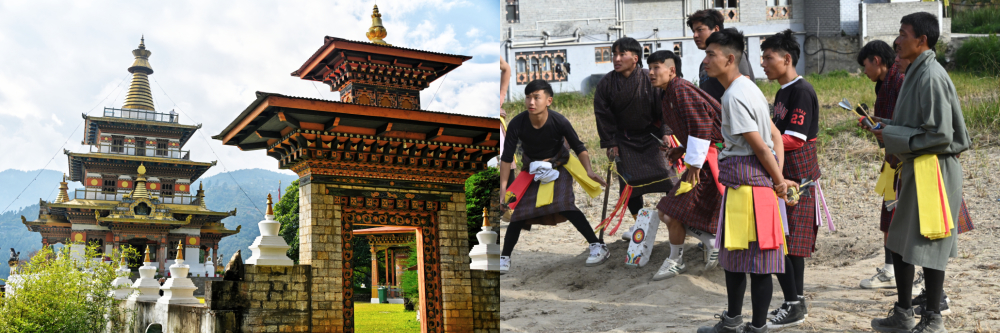
Punakha served as the seat of Bhutan’s government until the capital shifted to Thimphu in 1955 and remains one of the country’s most historically and religiously important places. Its lower elevation gives the valley a warmer climate and a lush landscape that contrasts with the higher valleys around Thimphu and Paro.
The centerpiece is Punakha Dzong, one of Bhutan’s most celebrated fortresses, standing at the confluence of the Pho Chhu and Mo Chhu rivers. Framed by mountains and water, the immense dzong remains an important religious and ceremonial center and one of the country’s finest examples of traditional Bhutanese architecture.