I’ve been to London twice, with my trips almost exactly a decade apart. Both times I was in London I was really taken back by how modern the city was, the beautiful landmarks, and how many fun things there are to do here. I’m not necessarily proud of it, but believe it or not London was the first place in my life I became intoxicated! I was 22 years old in the US Marines, and as I always refused to drink because it seemed that’s all that everyone else my age wanted to do, I became a sort of a rebel about it. After doing a six month cruise in the Mediterranean on an aircraft carrier, London was our final port call and drinking just sort of happened.I remember being absolutely amazed that it was possible to put that much liquid in your body, regardless if it was alcoholic or not. As far as the actual city goes, I had expected London to be similar to the United States since we’re both English speaking countries. For that reason, of all the places we stopped on this trip I was least intrigued by London, but it ended up being by far the best place during our entire cruise!
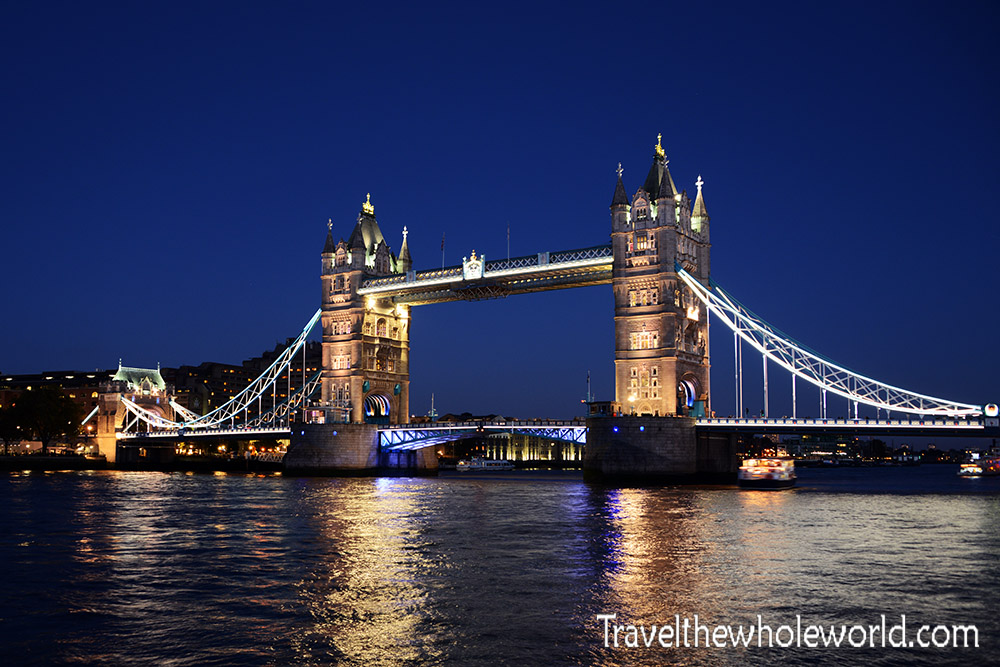
My first photo is of one of the city’s famous icons; the Tower Bridge that was finished in 1894. The bridge originally operated by a steam engine powered hydraulic system that was designed to raise the bridge for passing ships below. I either forget visiting this bridge or I somehow missed it during my first visit to London. It’s by far the most beautiful bridge in the city and still opens an average of three times a day. The original steam engines are now in a museum which was closed when I visited. Tower Bridge spans the Thames River which is photographed below.
Despite the two towers on Tower Bridge, the name actually comes from the Tower of London which the bridge was built directly next to. Above are two photos of the Tower of London, also known as Her Majesty’s Royal Palace and Fortress. Parts of this castle are so old they’re nearing the 1,000 year mark! The ancient castle is more of a collection of fortifications rather than a single structure. The photograph on the left shows the most famous building which is called the White Tower, and was built by William the Conqueror around 1078. On the back side of the castle, you can see how they creatively decorated it with flowers that look as if they are pouring out of one of the windows. This place was also closed for tours when I passed by, but is another place high on my list for the next time I’m in the city. The history and tales that happened at the Tower of London make it one of the city’s most important sites. The castle is the home of the famous royal crown jewels to stories of former wives of Henry the VIII that were beheaded here and supposedly still haunt the place.
On the opposite side of the Tower of London are several government buildings like these above. I’m not sure what the purpose of these on the left are, but I was surprised to find out this building on the right is actually city hall! I definitely wasn’t expecting this type of modern architecture of an official building in London.
Buckingham Palace is another famous place in London. I definitely didn’t have good lighting in this photo, but aside from that I didn’t find the building itself to be too impressive. I figured I’d come back for a night shot to see if it looked any better but never made it. The building’s history dates back to 1703 when it was built for the Duke of Buckingham. It was a private residence then and continued to be after King George III bought the place for his wife Queen Charlotte in 1762, which became known as the Queen’s Palace at the time. The palace holds the famous changing of the guard ceremony and at times is even open to tours. On the right is one of the guards who seems to be doing real security rather than ceremonial roles that other guards often perform at historical and cultural sites.
This building on the above is much more recent than the Tower of London and was built in the late 19th century. It’s known as the Old Admiralty Building and served as the command center for the British Empire’s navy. The statue on the left is located farther away in Trafalgar Square, but shows Lord Nelson. I spent five years in the US Marines, which are direct descendants from the British Royal Marines who were also under the command of the Admiralty complex. During my times in the Marines, we carried over a British tradition known as Mess Night. It’s a formal dinner with some very strange rules and games. One of them is no one is allowed to use the restroom until the highest in command orders a toast for Lord Nelson. Despite him being in the British Navy it seems even his American counterparts still admire him. He died in battle with Napoleon’s fleet, but not before he successfully won at overwhelming odds. His victory was credited with preserving the British themselves, as their entire country was at serious risk at the face of Napoleon’s invasion!
This building above is the Horse Guard and is right next to the Old Admiralty Building. Like its navy counterpart, this building once served for the headquarters of the British Army for several centuries until 1904. The building is still maintained today although its function now is entirely symbolic, including the Household Cavalry photographed on the right. These guys post on either side of the main entrance which leads to St. James Park and then St. James Palace. I visited this place on my first trip 10 years ago and nothing has changed! There were warning signs next to the horses that they bite, but otherwise if you’re willing to risk it it seems that you’re allowed to pet them.
Above are two more famous landmarks in London. They can actually be a bit confusing until someone explains all the names and purposes to you. During my first visit to London when I was just over 20 years old, I always thought Big Ben was the name of the actual tower and maybe even entire building. Both these towers on the left and center area actually part of the modern Palace of Westminster. The tower on the left is called Elizabeth Tower, and only the bell itself in Elizabeth tower is known as Big Ben. These days, I’m pretty sure everyone looks at the tower as a whole and calls it Big Ben as I always have. The Palace of Westminster is where the British parliament meets, specifically the two houses known as the House of Commons and the House of Lords. The palace has existed since the middle ages, but like most ancient buildings it was destroyed by various reasons during its long history. The palace’s worst destruction was in 1834 when a nasty fire essentially destroyed everything. It was rebuilt a few years later to its current design. The building on the right is called the Jewel tower that was built in the mid 1300’s. It was the only original medieval building to survive.
Almost directly in front of Buckingham Palace is the St James Garden. It doesn’t take long to pass through it but it has lots of beautiful flowers and other plants so it’s a nice walk. Even though there are lots of signs saying not to feed the birds, there were plenty of people throwing food out to these guys. I’m so used to the same three species of ducks and swans when I visit public parks that I was surprised to see a new species; I’ve never seen this guy on the upper left. Otherwise the swan on the right along with wood ducks seem to be guaranteed at public parks and ponds in Europe and North America.
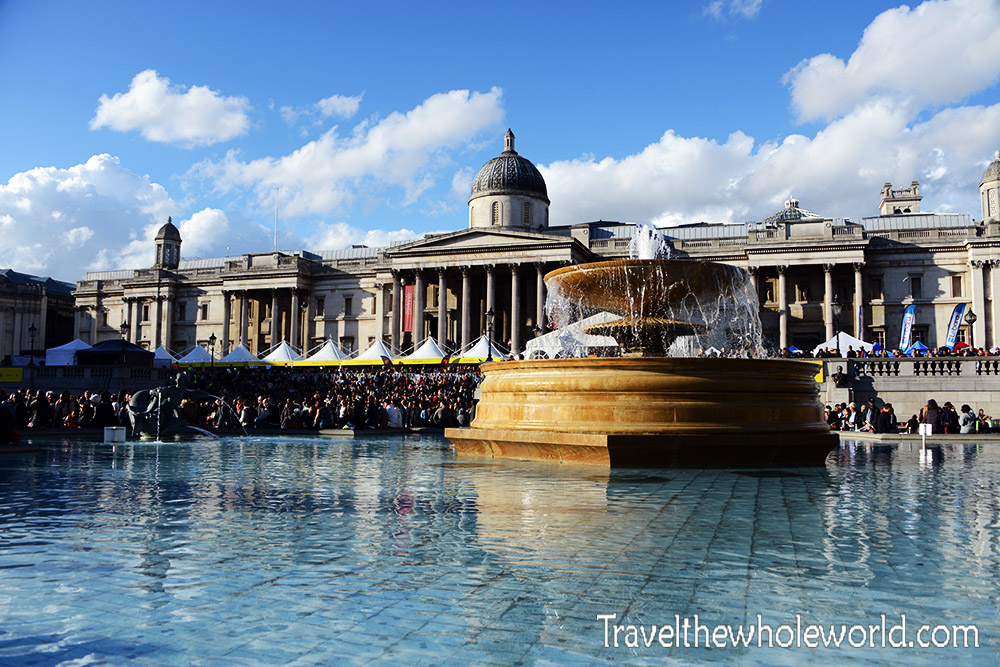
The Lord Nelson statue I showed earlier was here in Trafalgar Square. While the photograph showed the top of the statue it didn’t show how many people were crowded in the square below it. Also within Trafalgar Square is the city’s National Art Gallery photographed on the upper left. The day I was in the square they had a large African festival going on. The place was so packed it was a serious struggle to walk around. Of course Trafalgar Square had so many people because of the festival taking place, but I was really surprised how many people I saw in all parts of the city. I never remembered it begin so densely populated during my first visit. It could have been that visited in early October, so everyone was taking advantage of one of the last perfect days of the year.
Walking around the Thames River I came across this ship on the left that was kept in it’s own little enclosure. I never found out its purpose, but I assume it’s an original or rebuilt colonial ship from some famous voyage or battle. On the right is the optical illusion of a floating building with an unnecessarily long name, Take my Lightning but Don’t steal my Thunder. It was created by Alex Chinneck to give the illusion that the building’s center was completely removed yet the top remains floating. There were so many people in Covent Garden where the building is that it was difficult to explore. Apparently it looks like it’s floating from three sides!
With millions of people in London and many of them from different ethnic groups it’s no surprise to see protests about problems all around the world. When I visited London I was surprised by how often I heard people speaking to each other in different languages. It’s really one of the most international cities I’ve ever been to outside the United States. Above are two different protests going on in the city. I’m less certain of what the group on the left was raising awareness for, but I do know it was about something going on in Turkey. On the right you can see a protest about the Iranian president Rouhani. The protests accuse him of sentencing over 1,000 people to death in addition to other issues.
Of course I’ve used public transportation in places like Pakistan, Nigeria, Bolivia, etc, so you can imagine how excited I was to have what I thought would be an easy time here. Not only does everyone speak English here, this place is actually the origins of the English language! I took a late night train ride using their tube to try to get to my hotel. All was well until I tried to make a connection to another train. This should be incredibly simple, but at the time I didn’t realize it but the connection train was actually a different company than the tube system. So I ended up struggling to find my connection not understanding why it was so difficult to mark the platform. Ultimately I missed my train and someone selling tickets at a booth recommended I take the tube to another station and then take a bus, since the original train I wanted was done for the night. No cash or credit cards were excepted by the bus, so I had to go to the other side of the station to purchase a card and put money on that. I was a total nightmare since by now it was almost midnight. I couldn’t find the bus stand and was getting annoyed enough that I tried to take a taxi despite the insane price, but I didn’t have enough cash on me. Eventually I just took the tube to the closest stop possible and walked several miles at 1am to my hotel. By the time I arrived it was 2am and no one was at the lobby and the doors were locked. There was a number to call for late hours, but my phone was completely dead and no one was answering the door. I had to sit on the curb and use my laptop to charge my phone and finally was able to make the call. What a nightmare! I’ve seriously never had such bad luck in all the other countries I’ve been to regarding public transportation. Anyway, I did get to pass lots of drunk people that night like this guy on the upper right. Both these photos above were taken with my cell phone, you can see a bit of vomit on his pants if you look closely enough. The right hand photo was taken another day on one of the tubes. It can get much more crowded than this. The tubes or subway themselves I’d give an A+; very simple and easy to follow. It’s just a pain when you’re trying to combine buses and need to have a pass already or trying to get on the Great Western Railway and not realizing it’s a different system altogether.
I’m not sure what the occasion was, but during my second visit to London in October there were plenty of people dressed up as Zombies and other scary creatures. Of course you might think it was Halloween, but this was the very beginning of October still so Halloween was over three weeks away. There was definitely a location in the city where they all congregated, but I saw them everywhere, including the tube. I’m not sure who the first two characters are on the left, but I know on the right is Pyramid Head from Silent Hill.