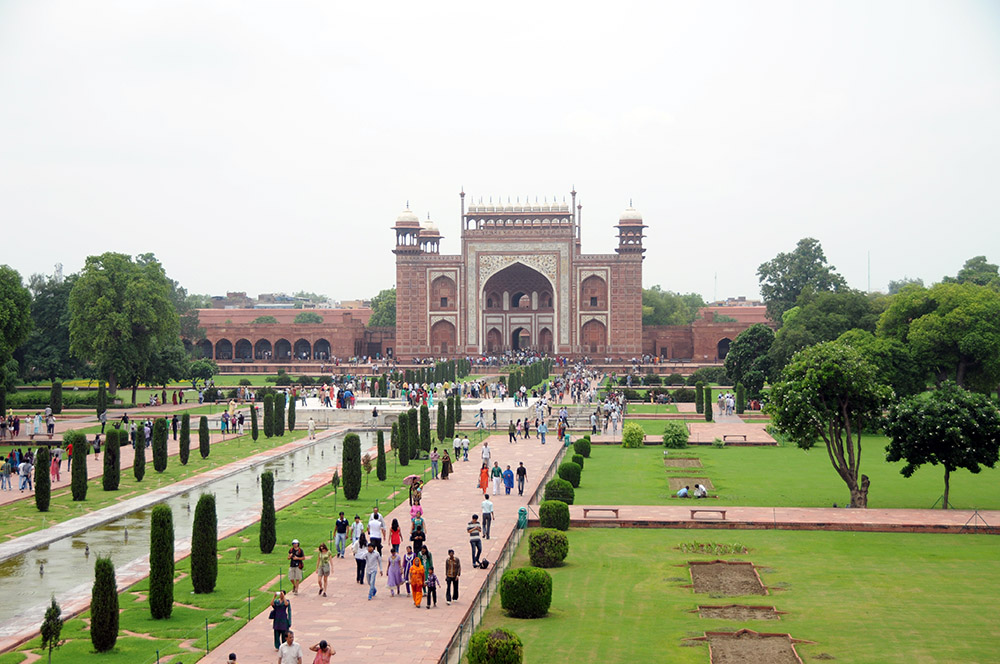
The distance between New Delhi and Agra isn’t especially far in terms of miles, but at the time my drive involved plenty of traffic, intersections, bicycles, and slow-moving trucks. After about four hours on the road, I finally arrived at the entrance to the Taj Mahal complex. Even before seeing the famous mausoleum itself, the scale and architecture surrounding the entrance made it obvious that this was much more than a single building.
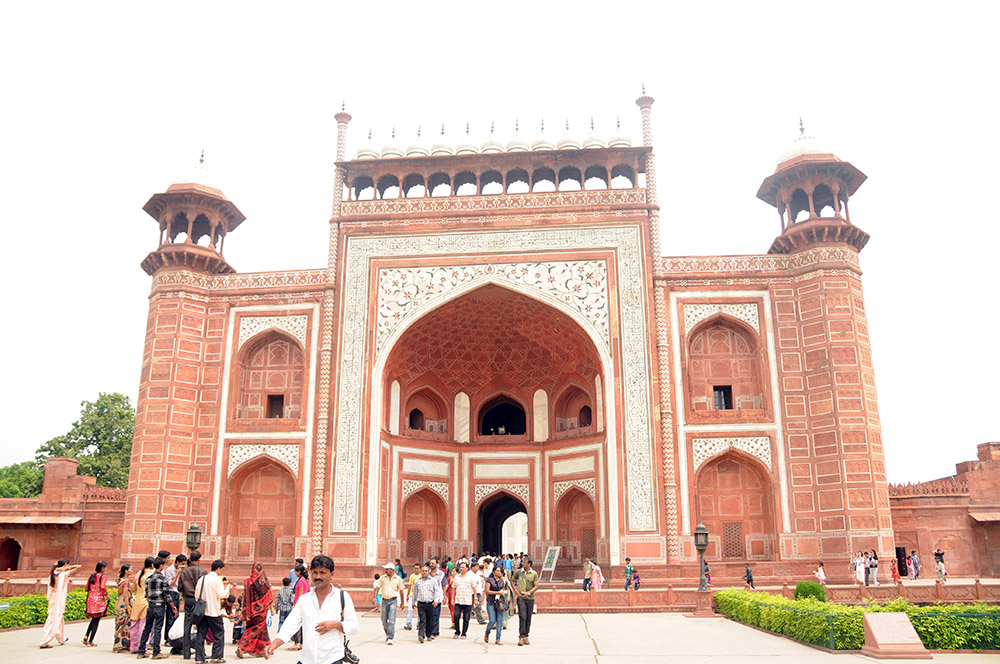
Passing through the monumental gateway gave me the first framed view toward the Taj Mahal itself. The entrance is impressive enough on its own, but it also makes the transition into the gardens and the white marble mausoleum beyond feel much more dramatic.
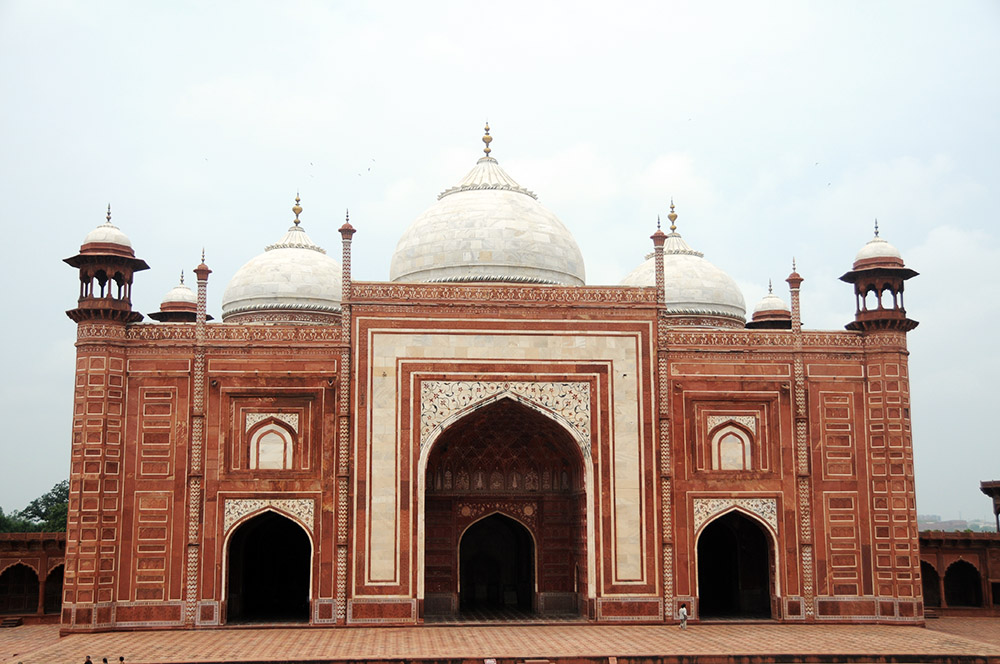
When most people imagine the Taj Mahal, they’re probably thinking only of the famous white marble mausoleum. In reality, the Taj Mahal is an enormous complex containing gardens, gateways, and several other impressive buildings. Above is the mosque, constructed from red sandstone and topped with three marble domes. It stands to the west of the Taj Mahal, facing toward Mecca. On the opposite side is a nearly identical building known as the jawab, creating the remarkable symmetry that defines so much of the complex.
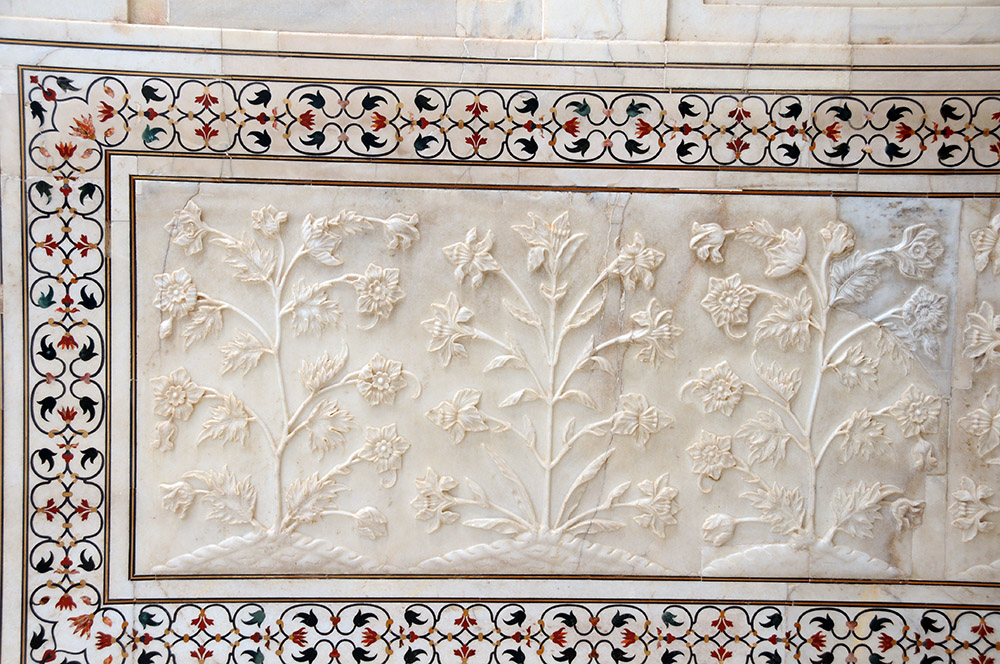
When I finally stood in front of the Taj Mahal, there was no question in my mind why it had become one of the most famous monuments in the world. Even after seeing it countless times in photographs, the building was far more impressive in person. From a distance its white marble gives the entire structure an almost perfect appearance, but up close you begin to notice the intricate carvings, calligraphy, and decorative stonework covering its surface.
The story behind the Taj Mahal makes the building even more remarkable. Mughal emperor Shah Jahan commissioned the mausoleum after the death of his beloved wife Mumtaz Mahal in 1631. Her death reportedly left the emperor devastated, and construction of the mausoleum began the following year. Thousands of craftsmen and laborers worked on the complex over the following decades, creating what eventually became one of the world’s great architectural masterpieces and an enduring symbol of love.
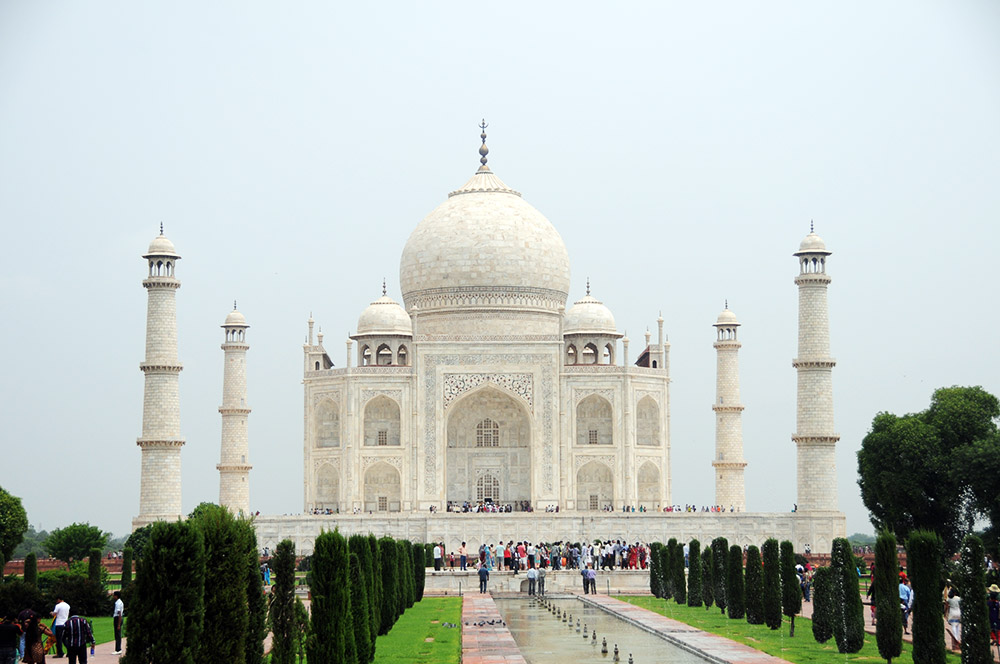
The Taj Mahal ultimately became the final resting place of both Mumtaz Mahal and Shah Jahan. Walking around the complex and seeing the craftsmanship firsthand made this one of the highlights of my entire trip through India. Photography wasn’t permitted inside the mausoleum when I visited, so most of my photographs focus on the exterior and its incredible details. While traveling in Pakistan, I also visited the tomb of Mughal emperor Jahangir in Lahore. Seeing other examples of Mughal architecture during the same journey gave me an even greater appreciation for the history and artistic tradition that eventually produced the Taj Mahal.
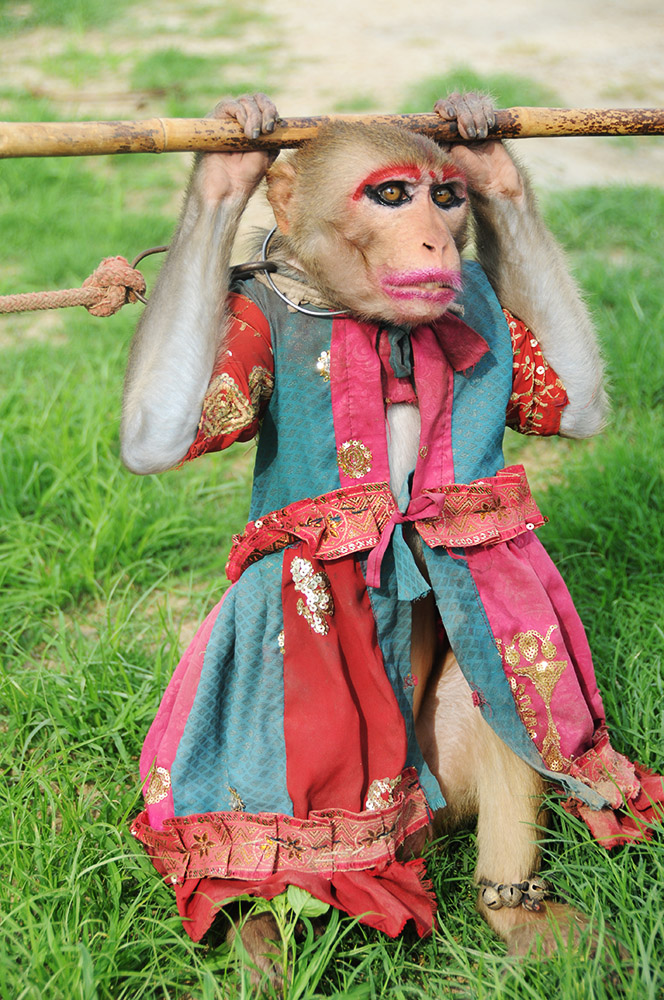
I had always thought the Taj Mahal was within India’s capital, but as it turns out it’s actually hours away in the city of Agra. There are plenty of trains connecting Delhi and Agra, but I chose to hire a driver. Halfway there, my driver stopped at a restaurant and encouraged me to visit a large silk shop nearby. By this point in my trip I had become familiar with drivers bringing travelers to shops where they could potentially earn a commission, so I wasn’t particularly interested. The unexpected highlight of the stop was this dressed-up monkey. Less than a year before I came to India, my sister had visited and apparently saw the exact same monkey, so it seems we both ended up with an unusual family travel photo from the road to Agra.