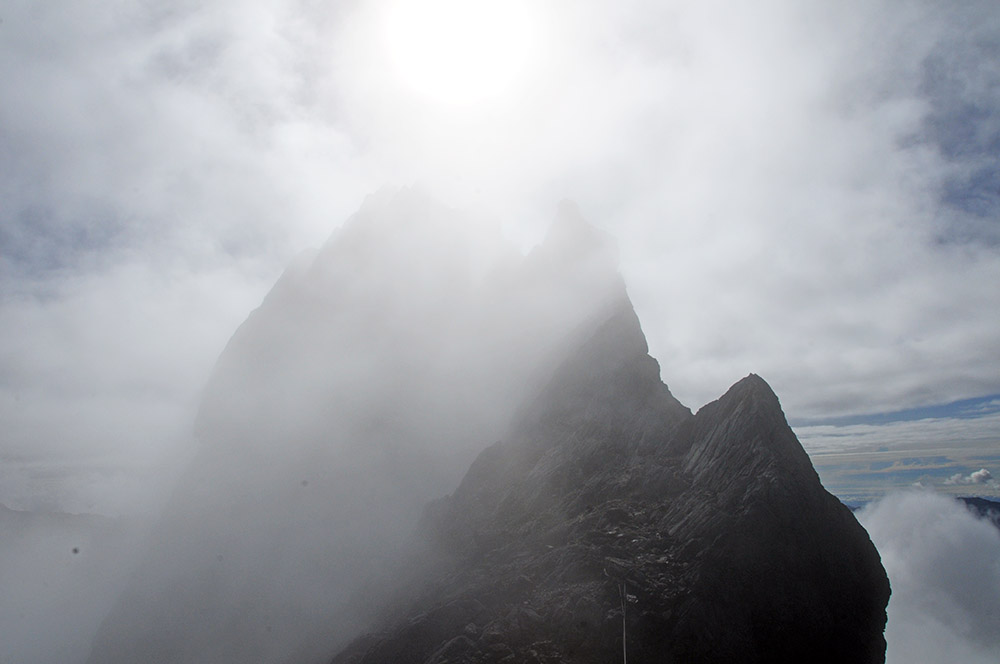
Carstensz Pyramid |
| Originally when the Seven Summits were first climbed, Mt. Kosciusko was chosen as the peak for this region since it was the highest in mainland Australia at 7,310 feet or 2,228 meters. As a Seven Summit, Mt. Kosciusko was hardly a challenge with a parking lot serving as its base camp and the summit reachable in only a few hours of easy hiking. The difficulty though is irrelevant; being the highest peak of Australia Kosciusko had earned its title, but this title didn't very last long. Soon after the Seven Summits were first conquered, climbers began to consider the entire continent of Oceania which added such places as New Zealand, New Guinea, and countless other Pacific Islands instead of simply mainland Australia.
With Carstensz Pyramid more than doubling the height of Kosciusko and more importantly being the highest peak in Oceania it became one of the Seven Summits. While the far majority of climbers agree with this choice, there are still a few who like to argue. Some dislike the idea of the Pacific islands being part of a continent and hold on to Mt. Kosciusko as the true summit. A ridiculous few even accept the island of New Guinea to be part of Oceania, but say that since the western half is politically occupied by Indonesia which is an Asian country, Mt. Wilhelm in the eastern side of the island is the true summit of Oceania. Too me Carstensz Pyramid is the obvious choice as the summit of Oceania for the following reasons. Geographically the island of New Guinea is located on the Indo-Australian plate, which makes its location in the continent unquestionable. Taking it a step further, the land is culturally native not to Asians but to Papuans who are descendants of aborigines from Australia. The final argument about the western half of New Guinea being part of Indonesia can be solved easily with a few examples. First off, Indonesia has only occupied western Papua as they call it since the 1960s. Indonesia's presence here is relatively new, especially when you consider that Carstensz Pyramid has existed for hundreds of thousands of years. Using this ridiculous logic though, Carstensz Pyramid would have been the highest mountain in Europe prior to 1960 since the Dutch controlled western Papua, and the Netherlands is a European country. Even if you did agree political boundaries the locals do not consider themselves Indonesians and instead Papuans. Only days before this trip, several tribes had banded together and once again declared independence from Indonesia which resulted in martial law and nearly caused my entire trip to canceled. Each to his own of course, but I personally feel anyway you look at the matter they all point to Carstensz being the true summit of Oceania, and with that in mind I set off in October 2011 to attempt what would be my 5th of the 7 summits. |
| From Nabire, I took one final flight on a charted aircraft to the center of West Papua heading towards a village known as Sugapa. My original plan on this trip was to fly to Tamika instead of Nabire and from there take a chartered flight to a village called Illaga. Tribal and political violence created fuel shortages in Tamika so it wasn't possible to land there. I was aware about the protests and military lock down in Illaga, and I worried about a similar problem happening in Nabire, but when I arrived to the city everything seemed perfectly normal there. The only issue we had was after checking in to the airport we were told we had to pay $50 to wait at our gate. We declined this generous offer and instead went to a restaurant to kill time and returned right as the plane was ready for take off. Our flight passed over untamed and remote rain forest that stretched as far as I could see. Since Sugapa is isolated by the rain forest and mountains, planes are the only connection to the rest of the world; most flights bring supplies for the villages. Motor bikes and your own two feet are about the only means of transportation once you arrive to these remote villages. |
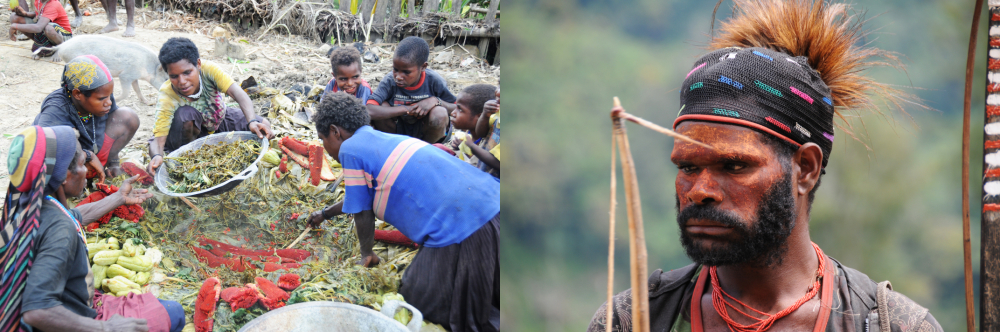
| Once in Sugapa, you can see an obvious difference of the local people compared to the Indonesians back in Nabire. My understanding is that around 60 or 70 thousand years ago aborigines from Australia crossed over into the island of New Guinea. Most of these guys looked intimidating but were quite nice once you tried to talk to them. They also were very short in height, it seemed the average male was around 5'5. |
| The kids in the villages were probably the poorest I've ever seen. Pretty much the only foreigners passing through here are either for Carstensz or missionaries and both are very rare I imagine, so they don't often get contact with Westerners. The kids have come up with some creative ways to have fun, such as the ball of trash turned into a toy by rolling it up and tying a string to it. I also saw several different kids who had taken some vines and rolled them together to form a wheel which they would chase it down steep hills. The picture on the right is sadly common on almost every kid's face. I'm not sure what the cause is of their sickness or congestion, but I saw dozens of kids with runny noses but no adults. You can't help your nose running I realize, but it drove me crazy that they allowed it to run down their face all day without wiping it off. Some kids had allowed it to stay on their face long enough until it froze into a bright green stalactite. |
| Our arrival to Sugapa is a big deal to the locals here. I didn't realize this huge village gathering was for us when it happened right outside the hut we were staying in. Despite being isolated from the rest of the world, the local tribes in West Papua know enough that when foreigners pass through your land there is a price to be paid. The only way to pass through the villages is to hire some of the people as porters, on the right one of the leaders determines who he will pick as porters for the journey to Carstensz Pyramid. The rumor was the porters were paid $800 each to join the expedition. You can imagine that in a land were most make less than a $1 a day, how incredible it must be to make $800 in just two weeks. It sounds like a enormous amount of money to me to hire a porter in these lands, but several people repeated it so it seemed to be true. |
| After the villagers seemed to have finished their debate we were all taken down on motorcycles to be dropped off at the starting point of our long trek. The ride was fast and dangerous but refreshing with the strong winds in the hot dry day. Members of my team had left on motorcycles ahead of me so I was surprised when I was dropped off by a river all alone. From the second I was dropped off I was nervous about something having gone wrong, but after 30 minutes passed the range of failures going through my head went from someone falling off a motorcycle to perhaps me being dropped off at the wrong point and the expedition departing without me. I attempted to ask the locals around me for information but no one spoke English. When I approached the bridge crossing the river men with machetes and bows and arrows motioned me to go away and to sit down. After another long wait a motorcycle finally came to pick me up and took me back to our hut. There we were told the local people were arguing about money again and had refused to let us pass through the village. The debate continued until darkness came and a full day was wasted. We had no choice but to spend the night in Sugapa which was never part of the plan. The next morning we repeated the process but instead of making it to the river after only 5 minutes of riding on the motorcycle we had a small road block. I saw one of our Indonesian guides hand over some cash and then we proceeded to a much larger road block seen on the upper right. |
| The second road block took some serious negotiating; we spent probably over an hour waiting while people argued back and forth which included some loud shouting at times. The photo on the upper left is right by the river where I was dropped off the day before, and was our third road block of the day. After this point, we were on our own two feet hiking the rest of the way to Carstensz. The village of Sugapa is close to 7,000 feet in altitude, but the motorcycles dropped us off at 5,000 feet, or about 1,500 meters. Despite being off the main road, the road blocks continued to ruin our day. The photo on the right is not the fourth or fifth, but actually the sixth road block we went into. I can't explain how frustrating it was to sit anywhere between a few minutes to hours waiting to see if we would be allowed to pass. A lot of us questioned if we would be forced to lose another day here due to the roadblocks or even worse have some type of escalation where we couldn't pass at all. |
| The road on the upper left was still being built which heads to our goal of Suanggama village, but at the top of the hill was as far as it had progressed. It seemed that each road block had a different method of defense or theme. One road block had logs on the trail, another guarded by bows and arrows, and one road block simply had a defiant man take a leafy branch and stick it into the dirt. One of our roadblocks was right by a bulldozer, and I was disappointed when a native didn't start it up and attempt to use it against us for this road block. It seemed after we got off this main road though the road blocks were done, and we made it to Suanggama village. Because of our wasted day yesterday, today's plan was to hike to Suanggama early in the morning and continue directly to Camp 1 which was in the rainforest. The road blocks had made our planned two hour hike literally end up taking 8 hours making it impossible to make it to Camp 1. Of course we all asked the question, what happens if we would pass the road blocks anyway?, but we were told we would be chopped by machetes if we ignored their protests. Two weeks after my trip here, a team was taken hostage by locals in Sugapa, one was held in captivity for almost two weeks but was not harmed. Above is some of the fences we had to cross once in the outskirts of the village, on the left is some of our porters carrying our gear. |
| Staying in the village was an interesting cultural experience minus the sleeping. During the evening we saw them preparing meals, playing with their kids, and had a huge crowd watching us curiously. I wondered if the locals here thought the six of us on this trip were out of our minds for wanting to hike through the rainforest and climb a mountain when they must figure there were much more interesting things to be done. I'm aware of a lot of tribal fighting on this island of New Guinea, but the village and tribe here seemed peaceful enough. My biggest fear was sleeping at night in the hut. Loud noises and nasty creatures came during the night and a few of them touched me. There were smooth things, furry things, clicking things. At one point in the night I had extended my arm to the right while it was still in the sleeping bag and felt it touch something which slowly walked away. Maybe since I was half conscious I immediately took my hand out of the sleeping bag and tried to feel in the area where my hand had just been, but whatever was there was gone. I was excited to be sleeping in a tent the next night. |
| On day 3 we left Suanggama to head into the bush, where our trek officially began. On the left is another photo of a stream of porters carrying group gear. I was surprised that some of them even travel barefoot and bring their families with them. The upper right photo is of the trail in the jungle, not very defined and simply made up of the local tribal people walking through it rather than an actual constructed hiking trail. |
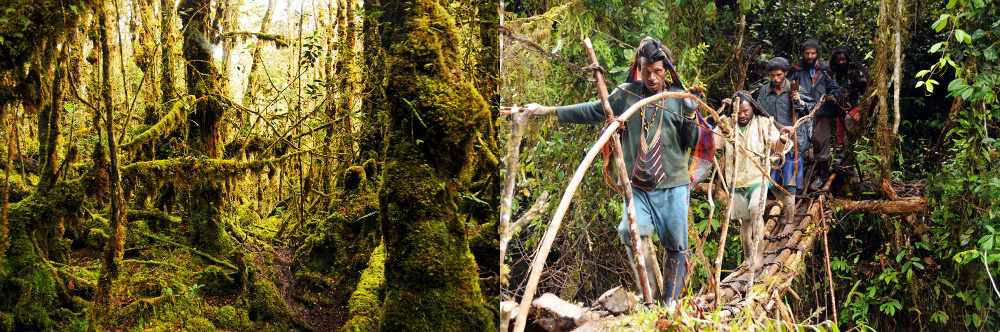
| After a few hours I definitely felt like I was in the jungle and was happy to finally be on my way towards Carstensz. There were lots of streams and rivers to cross, but all of them had bridges created by the local people. On the upper right is one of our barefoot porters carrying supplies across a bridge. Below on the left is our entire team and porters, nearly 30 people just to support 6 climbers! You can see why this is such a big deal to the locals to have a climbing team coming through. And with more than 20 porters, if they are honestly paid $800 each then you could see how and why this trip is so expensive. As we continued into the jungle, I was really disappointed to have another road block by some people guarding one of the bridges. On the lower right our guide and lead porter attempt to negotiate our pass. |
| Aside from the annoying road blocks we had early in the day, the terrain was difficult and came with plenty of dangers. On the upper left is an exposed slope you pass by that has a drop of over 25 feet. The terrain is slippery, so if you were to have a fall here you probably wouldn't die but certainly wouldn't be able to stay on the expedition and would likely have some broken bones. The plants and insects were another problem, I had touched a few sharp plants on accident for support or fell into them only to get tiny cuts. I continued my trek hoping that none of them contained undiscovered poisonous that would cause excruciating pain and/or sudden death. The spider on the upper right was in a field we came across that suddenly opened up in the rainforest. There trail on both sides was lined with some of the thickest spider webs I've ever seen, and the massive makers of the webs were sitting right in center like the guy on the upper right. No idea if this one is poisonous or deadly as well. |
| After a long day we reached camp 1 which was nothing more than a hill with vegetation cleared away to make room for our tents. With the thick overgrown rainforest surrounding us, there was hardly any space and our tents were forced into less than ideal areas. On the left is one of the tents for us climbers and on the right are the porters setting up the cook tent. Today was a serious challenge because we had so many up and downs with the terrain. The altitude gain was almost 2,000 feet from where we were dropped off by the motorbikes, but we had probably truly gained 4,000 feet if you added all the steep hills we had climbed. All we had essentially accomplished in the past two days was return to 7,000 feet or the same elevation we had been in Sugapa. This was discouraging but at least tomorrow we would be reaching new altitude. The hike today was exhausting but at least there had been no rain. I got into my tent dry and comfortable and it was warm enough to sleep with only a t shirt and shorts on. At night, my tent and I was visited by a curious frog who walked between my rain canopy and the tent itself. |
| The next day in the rainforest brought even more difficult terrain. There were more streams to cross and mud was becoming a serious problem. There never was a real trail in the rainforest like in a national park or any other hike you'd do, instead it was simply foot prints through the mud or over broken and fallen trees. Sometimes the roots of trees would create a huge entanglement rising several feet high and you'd have to use your hands and knees to climb them, getting wet and cold mud all over yourself. By now we were over 8,000 feet so it was extremely tiring having to pull yourself out of mud and and sometimes climb using both your hands and legs. Imagine the difficulty in an obstacle course that is only a few hundred feet long, and imagine doing that at 8,000 to 10,000 feet but for several miles. Above is a mossy creek and on the right is a slippery log that formed part of our trail and was actually several feet above the ground. Everything was so slippery and wet, some vines would act like trip wires and catch around your boots among other problems. It seemed each step we took in the rainforest was a chance to sprain an ankle or even something more serious. I had a real concern about slipping off a log or some injury that would cut my trip short. |
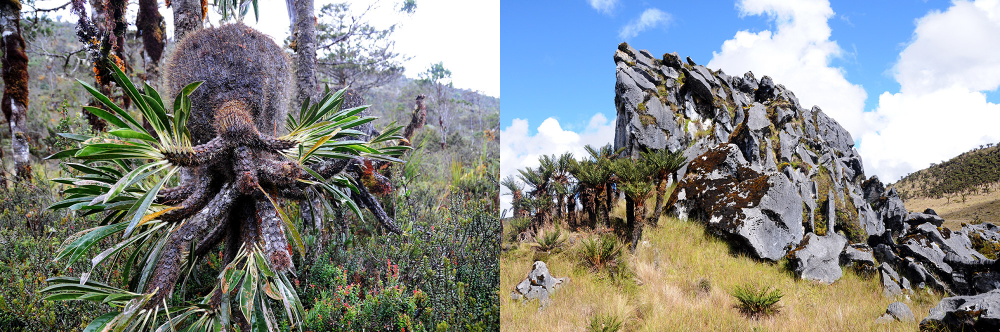
| The higher we climbed, the more the moss took over the forest until it finally consumed everything. Nothing here can escape the moss, except for the horrible pools of sludge. Seeing the palm like tree standing out of all the moss covered vegetation on the lower right was an amazing sight. It seemed like a glimmer of hope, that the moss and mud could consume everything but one beautiful plant had survived. The obstacle course was not any easier in the moss lands of Carstensz. |
| This camp was around 10,000 feet or 3,000 meters. Right by camp was a nice stream for cleaning and drinking, so I was able to walk in and get some much needed water and wash all the mud off of my pants which seriously went up to my waist. We had seen a confusing map of the area in Sugapa that showed the camps and direction through the rain forest to Carstensz, and while there seemed to be many contradictions we had been told it was a 5 day trek to the mountain including the trek to Suanggama village. As we were already beginning to feel the effects of the expedition, which was scary being how we had just started a few days ago, a deeply disturbing argument came up about how far we were from the mountain. Our understanding was that we had two more days until reaching base camp, but we were told by our guides that this was wrong and we actually had three days. This was incredibly depressing, and maybe something as simple as a single extra day can show how horrible the conditions are here. Later after talking with the guides our lead came back and said he made a mistake, and there were only two more days left! |
| By morning the rain stopped but everything was still muddy and now cold since we had gained some significant altitude. Above are two photos near Camp 2 of the morning fog, below is a photo of our food that wasn't quite my taste and I found difficult to eat. I also realized that after a day in the jungle and two days in the rainforest I had developed some nasty blisters on both of my heels that made it painful to put my boots on and to walk. I now had the added challenge of forcing food down and walking in pain to the next camp today. I was also worried about my blisters getting progressively worse as the trip continued, and what the combination of cold wet mud with unidentified germs thriving inside my boots might do to me. |
![]() |
| Day 4 was started by immediately going up a steep muddy hill and then following a ridge towards Carstensz Pyramid. We were out of the rain forest for sure, and now into a sort of cold and muddy high altitude jungle. The left photo is the beginning of our day, while the right shows some of the new strange plants that were up in the this alpine zone. As far as fallen logs and roots that create trip hazards go, this part of the trek had gotten better. But the trail here was even muddier than the rain forest and had its own new challenges. I'd rate this day as less challenging than the final day in the rainforest, but don't mistake that for being easy. I was depressed to find that we had left Camp 2 at 3,000 meters, at one point passed 3,600 meters or 12,000 feet and then dropped all the way back down to 3,000 meters by the time we reached Camp 3. The ups and downs of this trek, plus being cold and covered in mud really take a psychological toll. We basically gained a 1,000 meters today in hiking only to lose an equal amount in altitude, so our real progress was only getting closer to Carstensz but not higher in altitude. |
| Above is Camp 3 and my muddy pants after I've hung them up in a failed and desperate attempt to clean and dry them. I had gone to a tiny stream and washed them for about twenty minutes trying to get sometimes inches of accumulated mud off but it seemed to be impossible to clean. I even had mud on the inside my pants somehow, and my socks and blisters were also covered in mud. At this point I was feeling pretty miserable, but wasn't the only one. The other climbers on this trip also expressed their extreme discomfort and amazement at how we actually paid to be here, and not a small amount! It was in Camp 3 where we again talked about how far base camp was. Our expectations were that it was only another day of hiking, but being that we couldn't even see the mountain from here it that didn't seem very logical. Finally the sad news came back that now we had another two more days until reaching base camp. |
| At least Camp 3 had some interesting views, and though our team was depressed that we were farther away than we thought, it still lifted our spirits that we could see the first signs that we were nearing Carstensz Pyramid's homeland. What lifted my spirits the most was the possibility of being out of the mud. The rock formations on the upper left were taken after making it to camp, and on the right is the same photo but in the morning when the clouds had cleared. You can barely make out two sheets of glaciers on the right of both of the higher peaks in the photo. |
| On day 5 we left and headed for Camp 4, our last stop before we'd make it to base camp. Once again, I had hopped that the terrain would ease up and there wouldn't be anymore mud, but instead I found parts of this trek to have the deepest mud yet. Photos above show what some of the ground looks like, and it can be very tricky. I've seen mossy ground like on the upper left and stepped on to find firm support, and other times my boot would go straight through and I'd seriously drop almost two feet into mud. It's impossible to avoid and happens to everyone, so you'll end up getting mud up to your waist again and cold dirty water in your boots, the last thing my blisters needed. |
| The nice thing about this day was that it was relatively flat but really long, and we even had a period of beautiful sunshine in the afternoon. As far back as you can see in the photo on the upper left is where Camp 3 was, at the top of the forest and from there we had descended down the muddy meadows and followed the river. The rainforest's trip wires and slippery logs had failed to injure any of us, but the meadows had its on methods of creating pain and suffering. On the upper right you can see one of the many hidden streams that divide the meadows, and it's just one of the places you could accidently step into if you're not paying attention. Below is another shot of the river farther up which we had to cross via mossy rocks, and on the lower right is some of the interesting rock formations. Towards the end of the day I ended up getting lost from the trail and climbed a small rocky ridge. I could see smoke from where the camp was located, but wasn't sure exactly how to get there. I was with another climber and we spent almost an hour fighting deep holes, sharp rocks, and some thick vegetation until finally making it to camp. It was a dangerous and tiring trek and robbed me of what might have been the easiest day on the expedition! On the lower right is an example of some of the sharp rocks we were crossing while trying to find camp, but this photo was taken down in the meadows. |
| The easier day did come with a price though, once again we had lost a lot of altitude in the meadows while descending early in the morning, so when we reached camp 4 we were only at 3,500 meters or 12,000 feet. From camp to camp we were only a mere 500 meters higher even though it felt like we had climbed up to 14,000 or more. On the left is a photo of our tents in front of the next days challenge. On the right are the porters who have made it all the way to Camp 4. It had been Halloween the night before and someone had brought a witches hat which ended up in the hands of the porter. None of the porters speak any English so I wasn't able to explain Halloween to them, but the guy who had the hat on in the photo wore it for the rest of the trip and is probably wearing it to this day. |
| Today was started off by a simple trek through a short patch of woods that lead to the lake on the right. The 'wall' behind the lake was the worst challenge of the day, if not this entire trip so far. The zigzagging, extremely steep and muddy climb took over an hour. Some parts had some exposure where a fall would once again probably not kill you but leave you with some broken bones. I didn't take any pictures while climbing the wall and that is a big regret of mine, but taking my camera out was the last thing on my mind as we ascended it. We had some light rain while climbing the wall so it may have been muddier than it should have been, but I'd even prefer the rain forest to this section. |
| After the wall, the trail descended down some rocks and went right up to a large lake. By now the rain was pouring hard again so I had put my camera in my backpack. I do regret not photographing the lake, even in the rain. It was much larger than previous ones I had seen on this trip and even had a nice sandy beach. After the lake we had to ascend another very steep hill but it was much easier than the wall. This was followed by a short scramble that gained about 40 feet with a picture of the top of the scramble on the upper left; another place you don't want to fall. The little line you can see in the background is actually a trail of mud that we used to approach the scramble. By now though, the terrain was was mostly sandy and mossy rock, and finally the mud was no more. On the upper right is a photo near 14,000 feet. |
| Eventually on your way to base camp, you'll pass 14,500 feet, which is higher than any point in the continental United States. I was feeling very tired this day, and since my stomach was rumbling I knew it wasn't from altitude but probably food. I was well aware I was doing a horrible job of feeding myself on this trip, and I was worried that my body was eating itself out. I planned to force myself to eat everything I could once I arrived to base camp. Aside from food, the view on the upper right was all I needed to feel energized again. Even though I couldn't see much of it, I realized I was looking at the very bottom of Carstensz Pyramid where it begins to climb nearly half a mile into the sky. |
| Right around the corner from this view I could see base camp, or Camp 5 which was located at 4,330 meters or just above 14,000 feet. I climbed down and made it to the camp by the turquoise lake and looked forward to getting some final rest before the final push to the summit. The beautiful lake is a result of the mineral run off from mountains and gave a relaxing atmosphere despite the cold rainy weather. The temperatures here were above freezing but because everything was damp it felt like it was much colder than it actually was. On the upper right is some kind of memorial dedicated to some Indonesians who lost their lives here but I'm not sure the details of that story. |
| Our attempt on the summit began at 1am when we woke up, threw on our gear and did a one hour hike to the bottom of Carstensz Pyramid. I was extremely happy to see a night full of stars and not a single cloud in the sky. When we reached the base of Carstensz we ditched our trekking poles and this is where I saw the first rope on the upper left that was dangling vertically in the cool night. After the first climber going up sent a painful shower of scree and small to medium sized rocks, we decided to allow each climber to completely ascend the rope before another climber would start which ended up putting a lot of distance in between us. On the upper right is a climber's head lamp that is barely visible as he climbs into the night 50 feet above me. |
| Some parts of the summit day didn't require any ropes and we could group together again, but for the most part you're climbing this on your own strength and solo. On the left is a climber who had just finished a steeper part of the climb, on the right are two climbers ahead of me going up a near vertical wall. The grip here was excellent regardless if it is dry or wet. Just be prepared to deal with some serious exposure, so if you're not confident in climbing or have a fear of heights then you shouldn't expect to summit. |
| After the sun came out a few hours later, I was surprised by how well I could see the Freeport mine. This mine is the largest gold and copper mine in the world and it is even visible from space. It's run by an American company and is the single largest tax payer to the Indonesian government. The mine is a big reason why there is so much unrest on the island since West Papuans feel they are left uneducated and poor while the profits from the mine are sent elsewhere. Access through the mine for climbers is prohibited, but if you take the helicopter you'll be dropped off close by it, or about a 15 minute hike from base camp. On the right is a photo looking down of a steep section of scree I had just climbed. After this photo I turned around and continued climbing and would have slipped off the mountain if it wasn't for my rope. I looked down and for the first time on this trip I saw myself surrounded by ice. |
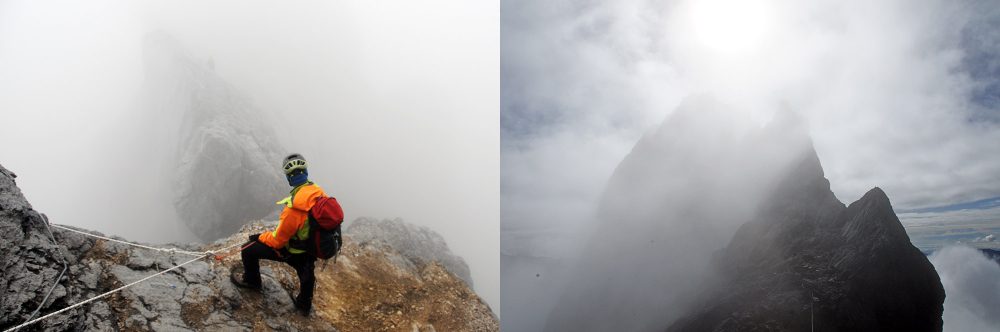
| I for some reason thought that after the gap the summit was only 15 minutes away or so, but it was actually an hour or two. Plus there were some smaller gaps to cross, and without the Tyrolean available these provided a bigger challenge. I sat in front of the gap on the upper left for about 10 minutes before me and another climber decided the best way to cross it. The trick was to ignore the ropes and climb down on the side of the rock and then use the ropes as support above you and jump across the open space below. On the upper right is the rope continuing up on the ridge as we approached 16,000 feet or nearly 5,000 meters. |
| All the way to the top, we continued to climb false summits like these seen above and a few more gaps. The most dramatic gap in my opinion was created by two sheer walls facing each other but were bridged together by a large boulder. Below the boulder was passing clouds and you had to cross by jumping down on the boulder, then jumping up in the air and pulling yourself up on another rock that had some extremely poor grip due to its shape. This was the biggest technical challenge for me, but those on the expedition who had done Everest and some serious rock climbing gave it a short look and climbed it quite easily. |
| After the summit, we began our descent back into base camp. Going down was much more enjoyable than going up since you simply rappel down much of the mountain. The fog eventually turned into heavy rain stealing some of the fun out of rappelling. A few times I felt like I was rappelling down a waterfall, other times the rain was so heavy that when I'd rappel the rope sliding through my figure 8 would cause i to spray violently in my face. Other challenges were sometimes not being able to rappel directly below and having to go over sideways which would cause the rope to get stuck on a rock above out of your sight. Suddenly as you were rappelling the rope would dislodge itself from the rock and give you a short drop. Of course the first time this happened I thought the rope had snapped and I might be plunging to my death for a second, but then I realized what had happened and was better prepared for the next few times it happened. Some of these ropes were incredibly thick while others thin, so each section was different as far as speeds go. Everyone here also went at their own pace, so I think most of us descended the mountain solo and we all regrouped several hours later after arriving to Camp 5. |
More on Carstensz than any other mountain I've climbed, once you reach the top you are only half way done. Don't forget my blisters that happened early in this trek. Instead of healing I was just rubbing off more skin every day, keeping my blisters wet and cold; probably the worst possible conditions for an open wound. The photo on the upper left was after summit day of my heals with them starting to go green. To get back to Sugapa I had to pass through the highlands, meadows and rainforests with each step being in pain. Plus the food wasn't really my taste, so I definitely wasn't getting enough calories for the descent. Carstensz Pyramid seemed bitter at its defeat, and everyday on our retreat we had some of the hardest rain we had ever seen while in West Papua adding to our misery. After summitting we returned to Camp 4 the following day crossing through the high altitude lakes and descending the 'wall' again. At camp, a porter who had been wearing shorts and was barefoot was unconscious from hypothermia. He was brought in and put next to the fire and after about 20 minutes he began to shiver. A cigarette placed in his hand motivated him to take occasional puffs from it. He eventually recovered, but for a scary moment we thought he might die, and come to think of it it's amazing no one else got hypothermia based on the conditions the porters work in. When I had been on the wall, I actually went down a wrong section and seriously had to rappel down by using the long grass that was growing there while I lowered myself into deep mud during a rainstorm. If the porter had collapsed here then he certainly would have not made it to camp in time as it's difficult getting your own body out of here much less carrying someone else's. After reaching camp 4, the next day we did a very long trek all the way to Camp 2 through the meadows at the top of the rainforest. I didn't remember the trek from Camp 2 to Camp 3 being all downhill on the way to Carstensz, but on the way back it seemed like we were climbing uphill non stop for hours. It was one of those hikes were you think you'll be able to spot your camp from the next peak, but instead we crossed the forested muddy ridge reaching peak after peak for hours until a steep decent making it to Camp 2 just before nightfall. | |
|
Carstensz Pyramid Climbing |
| Post a question or comment about climbing Carstensz Pyramid |
| Interested in climbing Carstensz Pyramid? Use this form to get in contact with my guides |
| © 2006 - 2013 Travel the Whole World. All rights reserved. The content on this website is copyrighted to George Kashouh and may not be reproduced, distributed, or made available in any form without written permission. Photos on this page may be used for blogs if they provide a link to "www.travelthewholeworld.com/carstenszpyramid.html" |